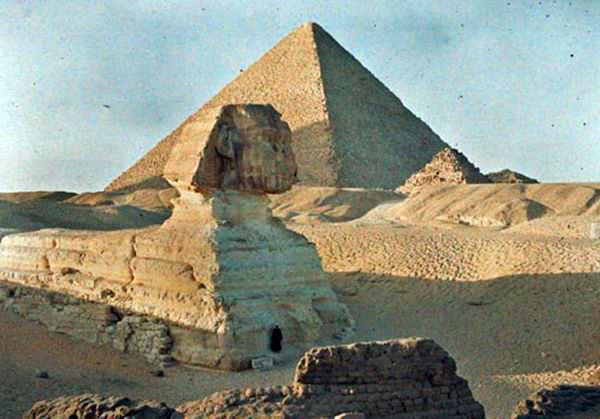
Warm desert light washes over the Sphinx as it rests in the foreground, its weathered body half-revealed against the sand, while a great pyramid rises behind like a fixed point on the horizon. The colorization brings out the pale limestone tones and the muted blues of the sky, giving a vivid sense of atmosphere that early 1900s visitors would have felt when arriving at this iconic Egyptian landscape. Even without modern crowds or signage, the scene reads instantly as the Giza Plateau—monumental, exposed, and quietly commanding.
The Sphinx’s damaged face and eroded flanks hint at centuries of wind, grit, and human contact, reminding us that “ancient” is also a story of continual change. Sand gathers in soft drifts along the contours of the statue, emphasizing how the desert can both bury and preserve, revealing different parts of the monument from one era to the next. Behind it, the pyramid’s crisp geometry contrasts with the Sphinx’s rounded, worn surfaces, a visual dialogue between endurance and slow decay.
Early 20th-century Egypt held a particular fascination for travelers, scholars, and photographers, and images like this helped shape how the wider world imagined the country’s past. For WordPress readers searching for Egypt 1900s photos, Giza history, or colorized historical photographs, this view offers a striking bridge between eras—modern enough to feel close, old enough to carry the weight of antiquity. The subtle hues make the familiar scene feel newly immediate, inviting you to linger on the textures, the scale, and the silence of the desert.