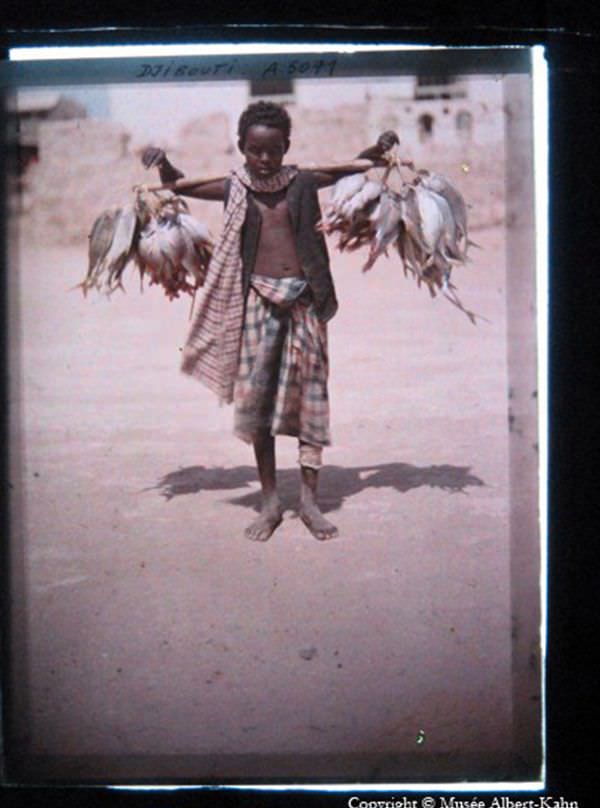
Against a pale, sun-bleached backdrop, a young street vendor stands barefoot in Djibouti, arms stretched wide to balance two heavy bundles of freshly caught fish. The colorization brings out the warmth of the sand and the muted tones of his cloth wrap and vest, while the silvery bodies of the fish catch the light in a way that feels immediate and real. Even without a precise caption beyond “Djibouti, 1900s,” the scene reads as a candid moment of work and endurance in a port town shaped by heat, trade, and daily necessity.
In the early 20th century, Djibouti’s shoreline and markets tied the Horn of Africa to wider networks across the Red Sea and the Indian Ocean, and fish like these were both food and commerce. What stands out is the practicality of the carrying method—bundles slung from each hand—suggesting short-distance transport from landing point to buyers rather than long storage. The simple architecture in the distance, softened by glare, hints at an arid settlement where shade and water mattered as much as currency.
Colorized historical photography can sometimes feel like a modern overlay, but here it helps restore texture: dust underfoot, harsh daylight, and the subtle contrast between fabric and skin. For readers searching Djibouti history, 1900s daily life, or vintage colorization projects, this image offers a grounded look at labor beyond official portraits and colonial streetscapes. It invites questions about who bought the fish, where it was sold, and how many such journeys filled the hours between sunrise and dusk.