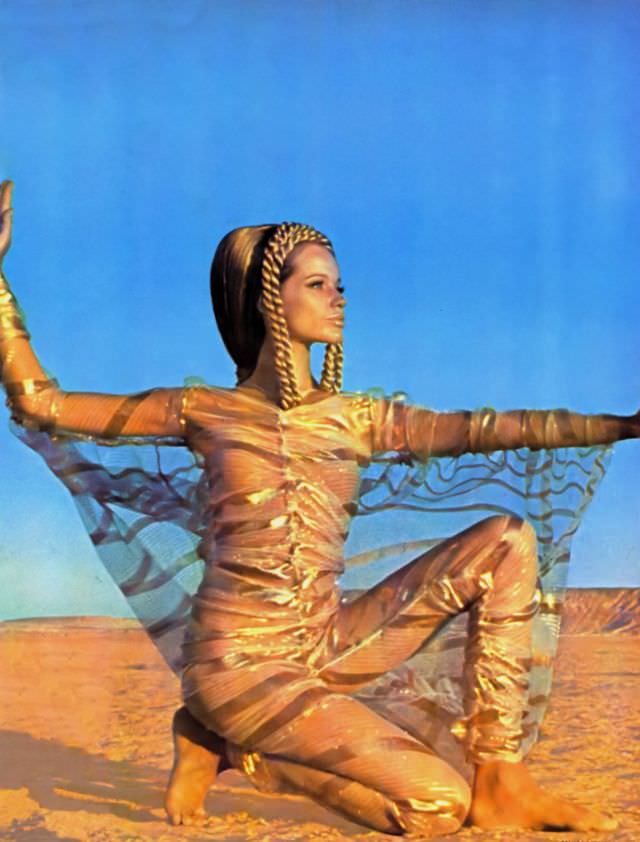
Against a hard, cloudless blue sky, Veruschka takes a sculptural pose in the sand, one knee raised and both arms extended as if measuring the horizon. The sheer organza djellaba catches the light in amber-gold, its transparency and shine revealing the body’s lines while still reading as a robe with airy, winglike sleeves. Braided hair frames her face beneath a smooth head covering, turning the model into an emblem—part desert traveler, part modern icon.
The composition leans on contrast: warm dunes below, cool sky above, and a figure held in crisp profile between them. Organza—so delicate in a studio—becomes something tougher here, rippling and clinging in the open landscape, while the metallic sheen and fitted underlayers add a futuristic edge. The stillness of the setting makes every detail louder: the glint along seams, the translucent fabric hovering off the arms, and the elongated silhouette that defined late-1960s fashion photography.
Published by Vogue in 1967, the image belongs to an era when editors and photographers pushed couture out of salons and into elemental backdrops, letting wind, sun, and vast space do part of the styling. The djellaba reference signals the decade’s appetite for global forms, reinterpreted through high-fashion materials and a boldly modern attitude. What remains most memorable is the mood—enigmatic, theatrical, and intensely graphic—an enduring snapshot of 1960s fashion and culture at full stretch.