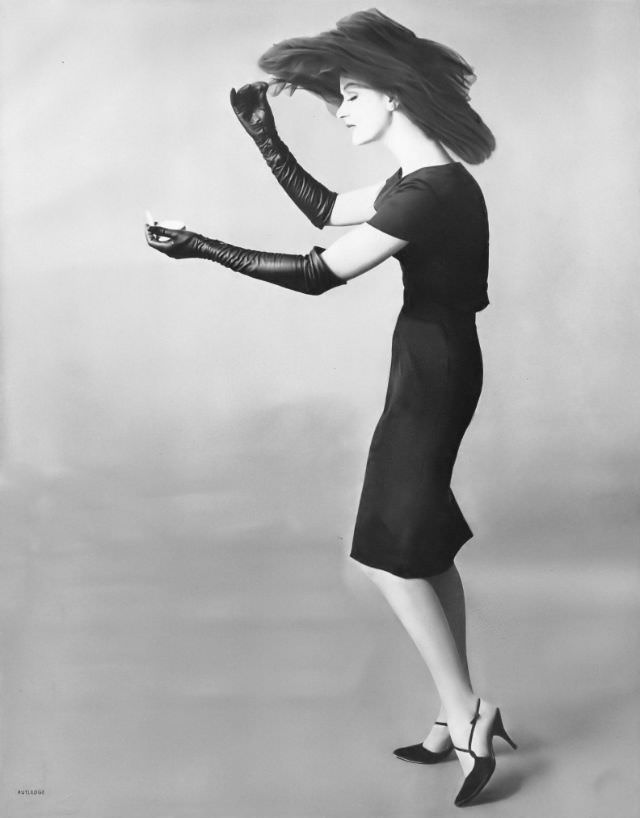
Poised in profile, Betsy Pickering turns a simple studio backdrop into a stage, her movement caught mid-gesture as if the air itself were part of the styling. The black silk crêpe dress by A. Goodman reads as pure 1959 modernism—clean lines, a close fit through the bodice, and a skirt that narrows with quiet precision. Long, glossy opera gloves extend the silhouette, while slim heels and a delicate strap at the ankle sharpen the look’s understated drama.
A sense of cinematic momentum runs through the photograph: her hair lifts and sweeps back, suggesting a quick turn or a gust timed to perfection. The lighting keeps the focus on form rather than ornament, allowing the deep black of the dress to stand out against the pale ground in crisp contrast. With no jewelry competing for attention, the elegance comes from restraint, tailoring, and the confident posture of a model trained to communicate mood in a single frame.
Fashion historians often point to late-1950s editorial imagery like this as a bridge between classic cocktail-dress glamour and the more graphic, streamlined aesthetics that would soon dominate. Here, the A. Goodman design and Pickering’s controlled energy deliver an unmistakably mid-century statement: sophisticated, urban, and ready for the spotlight. For readers searching vintage fashion photography, 1950s couture styling, or Betsy Pickering’s iconic modeling years, the image remains a compelling study in how simplicity can be made unforgettable.