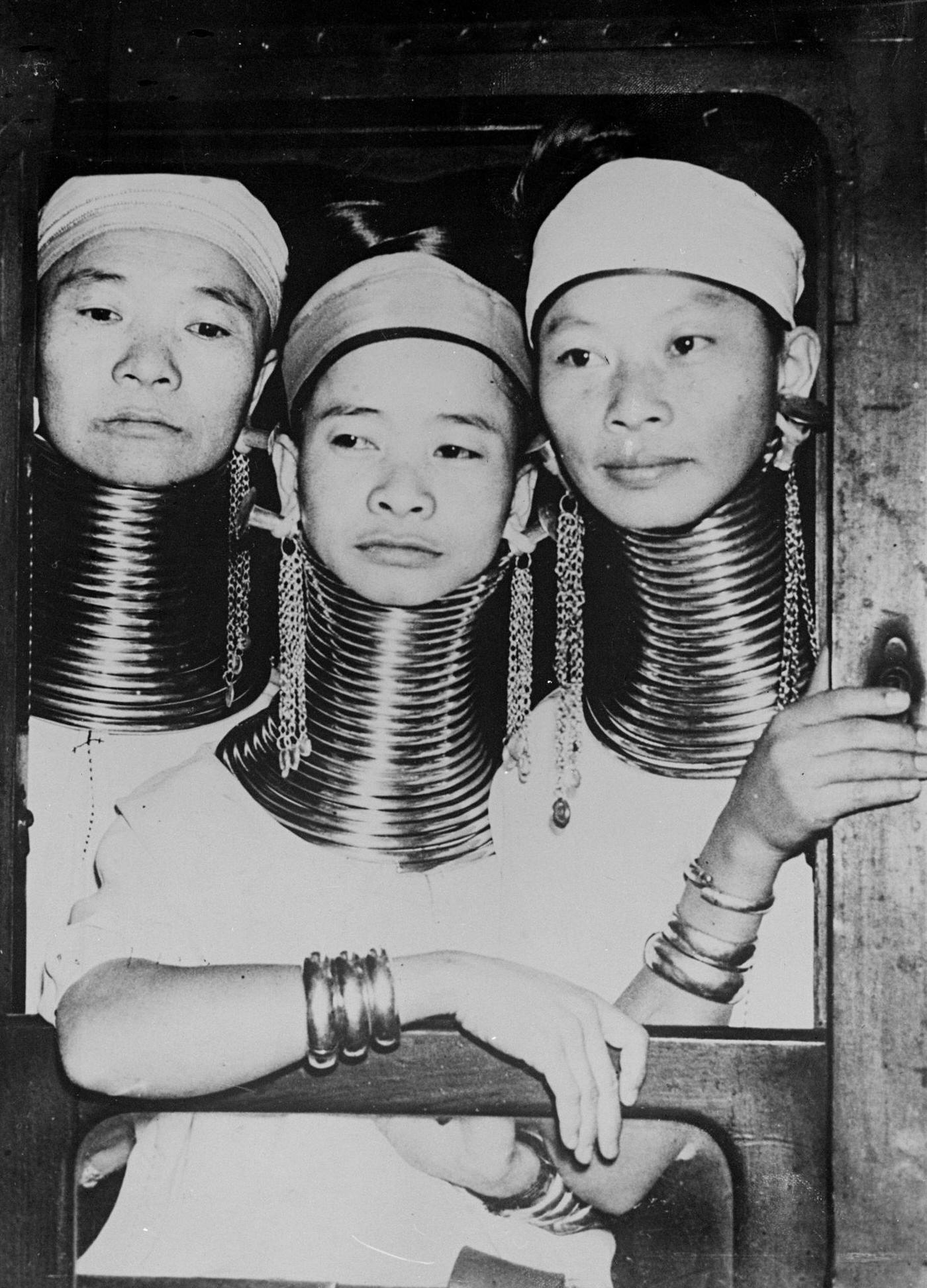
Framed tightly in a doorway or carriage window, three Kayan Lahwi women face the camera with a calm, unguarded steadiness. Their most striking adornment is the stacked brass neck rings, catching the light in smooth bands that turn the throat into a sculptural column. Headscarves sit low across their hairlines, while delicate earrings and layered bangles add texture and movement against plain clothing.
The title places them in London in 1930, a detail that hints at the era’s fascination with “exotic” display and the complicated circuits of travel, exhibition, and colonial curiosity. Yet the photograph resists spectacle in its mood: the women are close together, shoulder to shoulder, occupying the frame on their own terms. One rests her arm across the sill, another grips the edge of the opening, small gestures that make the scene feel lived-in rather than staged.
As a document of fashion and culture, the image points to how identity can be carried in materials—metal, cloth, and the practiced weight of tradition—while also reminding us how often such traditions were filtered through Western lenses. For researchers and collectors searching terms like “giraffe women of Burma,” “Kayan neck rings,” or “London 1930,” the photograph stands as both an iconic portrait and an artifact of its moment. Seen today, it invites a slower look: at craftsmanship, at dignity, and at the histories that brought these women before a London camera.