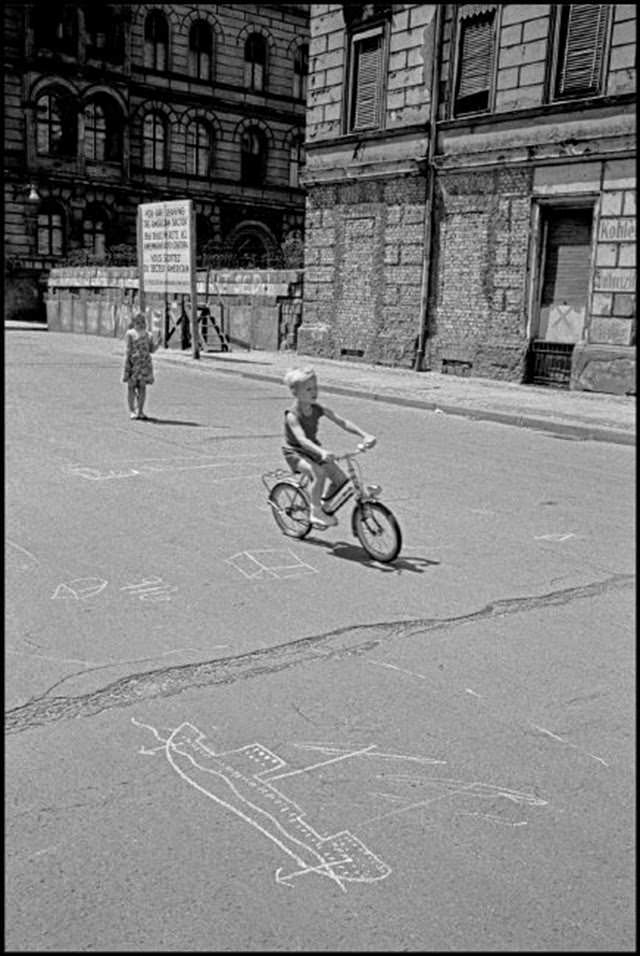
In Berlin Wedding, childhood moves through a landscape shaped by division: a boy pedals a small bicycle across an empty stretch of street while chalk drawings sprawl on the pavement like a private map of imagined worlds. Behind him, a second child lingers closer to the edge of the frame, dwarfed by heavy masonry facades and shuttered windows. The scene feels quiet, even ordinary, yet the built environment hints at a boundary nearby—an everyday neighborhood pressed up against the reality of the Berlin Wall.
A low barrier and a prominent warning sign stand in the background, turning the street into a threshold rather than a thoroughfare. The architecture—aged brickwork, patched surfaces, and deep-shadowed entrances—adds a sense of postwar wear, the kind of urban texture common in historical photos of West Berlin’s border districts. In that setting, play becomes both a pastime and a subtle act of normalcy, as children occupy space that politics tried to define and restrict.
Moments like this help explain why images of children playing at the Berlin Wall remain so resonant for anyone searching the history of Berlin Wedding, Cold War Berlin, and daily life near the border. The contrast between chalk games and hard boundaries makes the photograph memorable: innocence in the foreground, control in the distance. For readers exploring the human side of divided Germany, it’s a reminder that even in tense times, streets still held laughter, wheels still turned, and kids still drew their own lines on the ground.