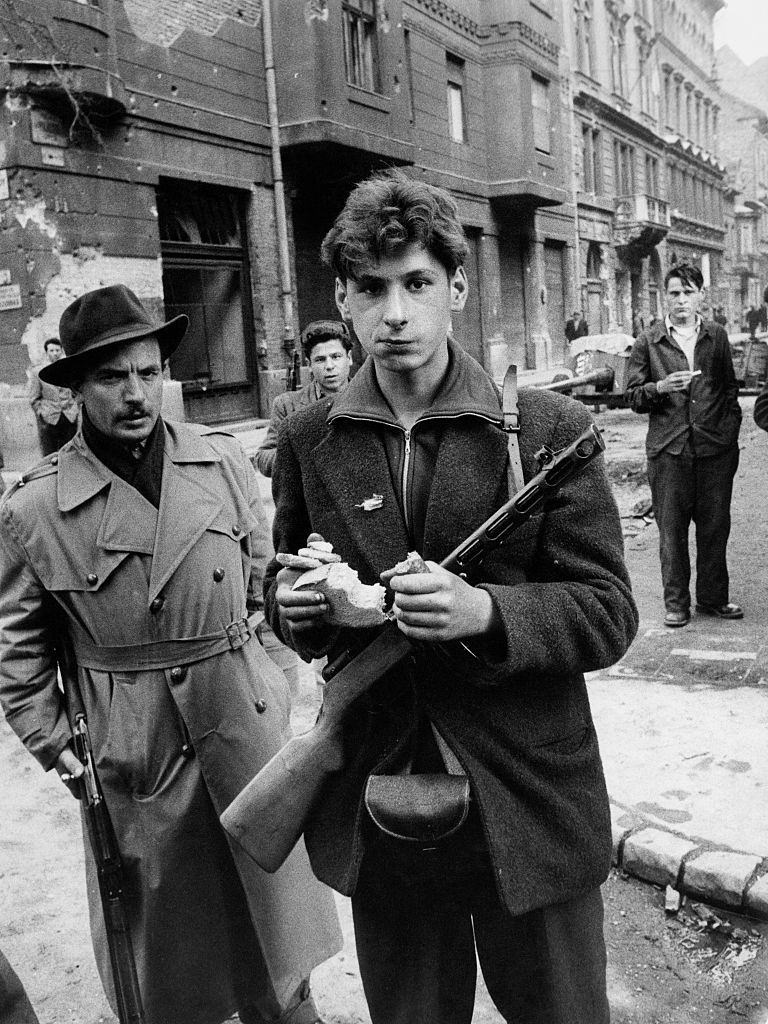
A teenage boy stands in the foreground of a battered Budapest street, a rifle slung across his chest while he grips a rough piece of food in his hands. His gaze is steady and unsmiling, the kind of expression that suggests a childhood interrupted by sudden danger. Behind him, scarred building façades and scattered debris hint at recent fighting, while passersby linger with the wary posture of people listening for the next burst of gunfire.
November 1956 was the climax of the Hungarian Revolution, when ordinary citizens—students, workers, and improvised fighters—rose against Soviet-backed control and paid for it in blood and exile. The stark contrast between the boy’s youthful face and the weapon he carries tells the story more sharply than slogans ever could. Even the small details—the coat collar turned up, the strap cutting diagonally across his body, the onlookers caught mid-step—evoke a city living through a civil war atmosphere, where each corner could become a front line.
For readers searching the human side of the 1956 Budapest uprising, this historical photo distills the revolt into a single, unforgettable moment. It invites questions about how resistance is formed, how fear and resolve can coexist, and what “tyranny” looks like at street level when it reaches into daily life. As a piece of Hungarian Revolution history, it remains a powerful reminder that revolutions are not only fought by leaders and armies, but also by the young who found themselves forced to choose.