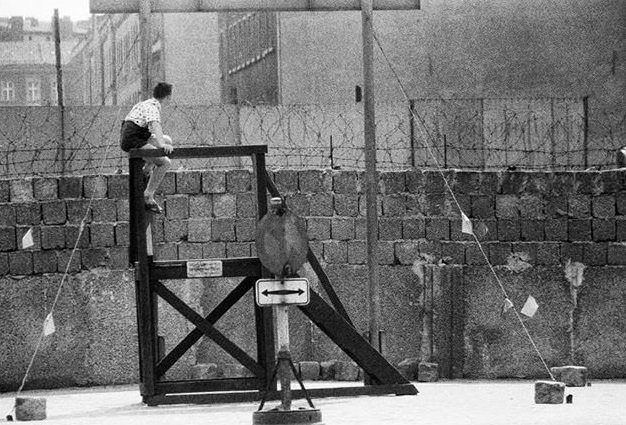
On a makeshift wooden platform beside the Berlin Wall in Wedding, a child perches at the top while another figure lingers below, turning a fortified boundary into an improvised playground. Concrete blocks, barbed wire, and a rough stone barrier fill the frame, yet the strongest impression is the casual way youthful curiosity presses up against a landscape built for control. The composition underscores a stark contradiction of divided Berlin: everyday life continuing in the shadow of engineered separation.
The scene is crowded with telling details—wire coils, warning elements, and the hard geometry of the Wall—contrasted by the lightness of play and movement. Even without readable slogans or clear signage, the barriers speak their own language of restriction, surveillance, and fear, while the children’s presence suggests resilience and a search for normality. In this Berlin Wedding moment, the boundary is not only political infrastructure; it becomes part of the neighborhood’s physical and emotional terrain.
For readers interested in Cold War history, the Berlin Wall, and street life in divided Berlin, this photo offers a vivid, human-scale entry point. It invites reflection on how communities adapted to an imposed border, and how children in particular navigated spaces shaped by conflict—sometimes with defiance, sometimes simply with imagination. The result is a quietly powerful document of Berlin Wedding, where the ordinary and the extraordinary collided day after day.