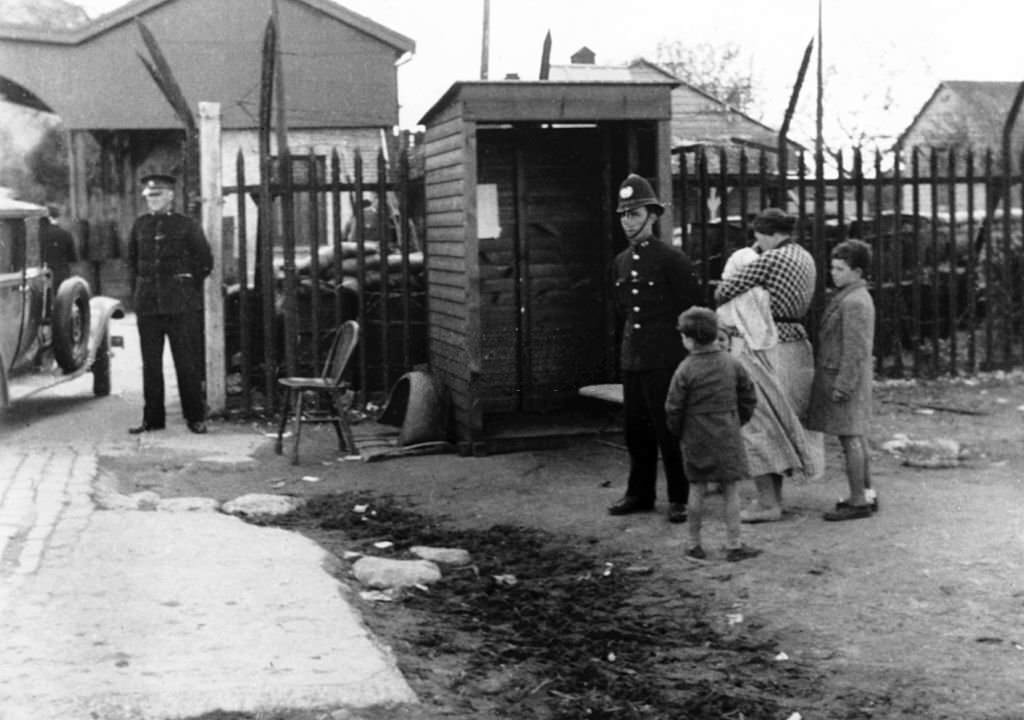
At Gibraltar’s guarded threshold during the Spanish Civil War, order is enforced with uniforms, rifles, and a narrow passage that decides who may enter and who must wait. A tall iron fence frames the scene, its sharp uprights and rigid lines echoing the hard boundaries of wartime Europe, while a small wooden guard hut anchors the checkpoint like a fixed point in a shifting crisis. Even the roadside—muddy, uneven, and strewn with patches of stone—suggests how quickly ordinary streets could become corridors of displacement.
Near the sentry, a small group of Spanish refugees stands close together, their bodies turned toward the gate as if bracing for instructions. A woman holds a bundled child, and another child lingers nearby, the family’s quiet posture contrasting with the formal stillness of the British guards. The moment feels procedural rather than dramatic, yet that is precisely its power: refuge here is not a sweeping gesture but a controlled entry, measured and monitored.
Such images of Gibraltar in the Spanish Civil War illuminate the politics of refuge at a strategic crossroads, where humanitarian need met imperial security and strict border management. The checkpoint becomes more than a physical barrier; it is a symbol of how civil wars spill outward, reshaping lives far beyond the front lines. For readers searching the history of Spanish refugees, British sentries, and Gibraltar’s role in wartime migration, this photograph offers a stark, human-scale window into a tense passage to safety.