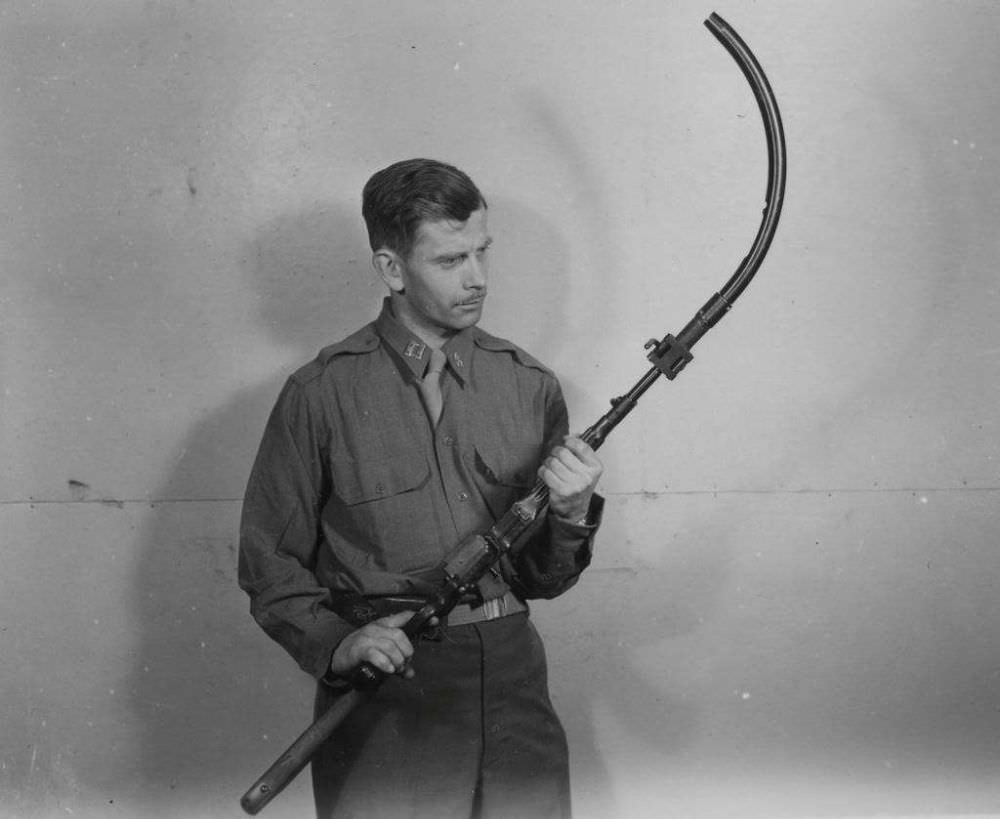
A soldier stands against a plain backdrop, studying a rifle fitted with an oddly arched barrel extension that looks more like a piece of industrial piping than a battlefield accessory. The curve dominates the frame, turning an otherwise familiar weapon into something experimental and faintly unsettling, as if engineering ambition has physically bent the rules of marksmanship. In a single glance, the photo hints at the wartime urge to outthink an enemy with hardware as much as with tactics.
Krummlauf—literally a “crooked barrel”—was one of WWII’s most famous weapons oddities, designed to let a shooter fire around corners or from behind cover without exposing the body. That promise of safer urban fighting came at a cost: forcing bullets through a bend stressed metal and ammunition alike, reducing accuracy and shortening the life of the attachment. The image works as a quiet document of that tension between clever concept and stubborn physics, capturing the moment when theory is held up for inspection.
For readers interested in WWII inventions, experimental firearms, and the strange paths military technology can take, this post explores why curved-shot devices were pursued and why they remained a niche solution. The photograph’s simplicity—one figure, one modified rifle, no distractions—invites you to focus on design details and imagine the real-world conditions that demanded them. It’s a compelling entry point into the broader story of how desperation, innovation, and practicality collided in the workshops behind the front lines.