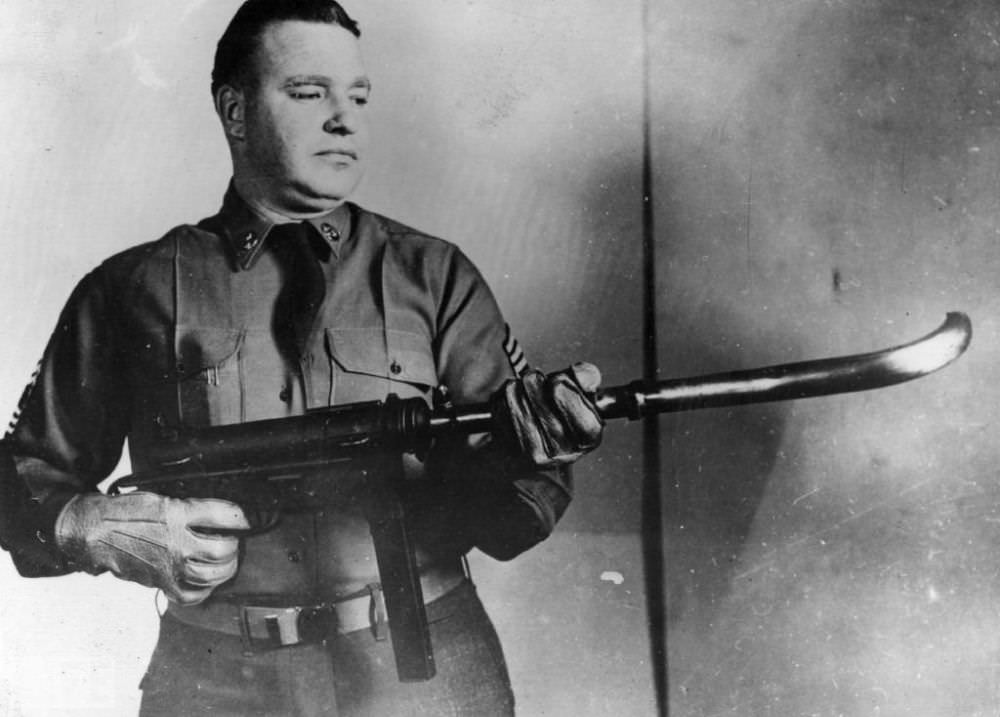
Few wartime inventions look as uncanny as the bent muzzle attachment cradled in this photograph, where a uniformed soldier demonstrates a firearm fitted with a curved barrel extension. The odd silhouette—part tool, part experiment—hints at the desperate ingenuity of WWII weapons development, when engineers chased any advantage that might keep a shooter safer behind cover. Even without a visible caption, the image telegraphs a trial-like atmosphere: posed, deliberate, and meant to prove that an impossible idea could be made real.
Krummlauf, the notorious attempt to “bend bullets,” sits at the center of this story: a device designed to redirect fire around corners, through openings, or from protected positions where direct line-of-sight was dangerous. In theory, a curved barrel and specialized setup could let soldiers engage targets without exposing themselves—an early, mechanical answer to problems that later decades would tackle with optics, cameras, and remote systems. In practice, the concept wrestled with brutal physics, as pressure, heat, and projectile stability punished anything forced to travel a bend at speed.
What makes the Krummlauf so compelling for historians is how clearly it reflects the era’s mindset—innovation pressed into service under extreme conditions, with experimentation happening alongside mass production. For readers searching WWII inventions, secret weapons, or unusual firearms prototypes, this photo offers a stark reminder that not every “wonder weapon” was built to last; some were built simply to be tried. The result is a rare glimpse into the boundary between imagination and engineering, captured in one arresting moment.