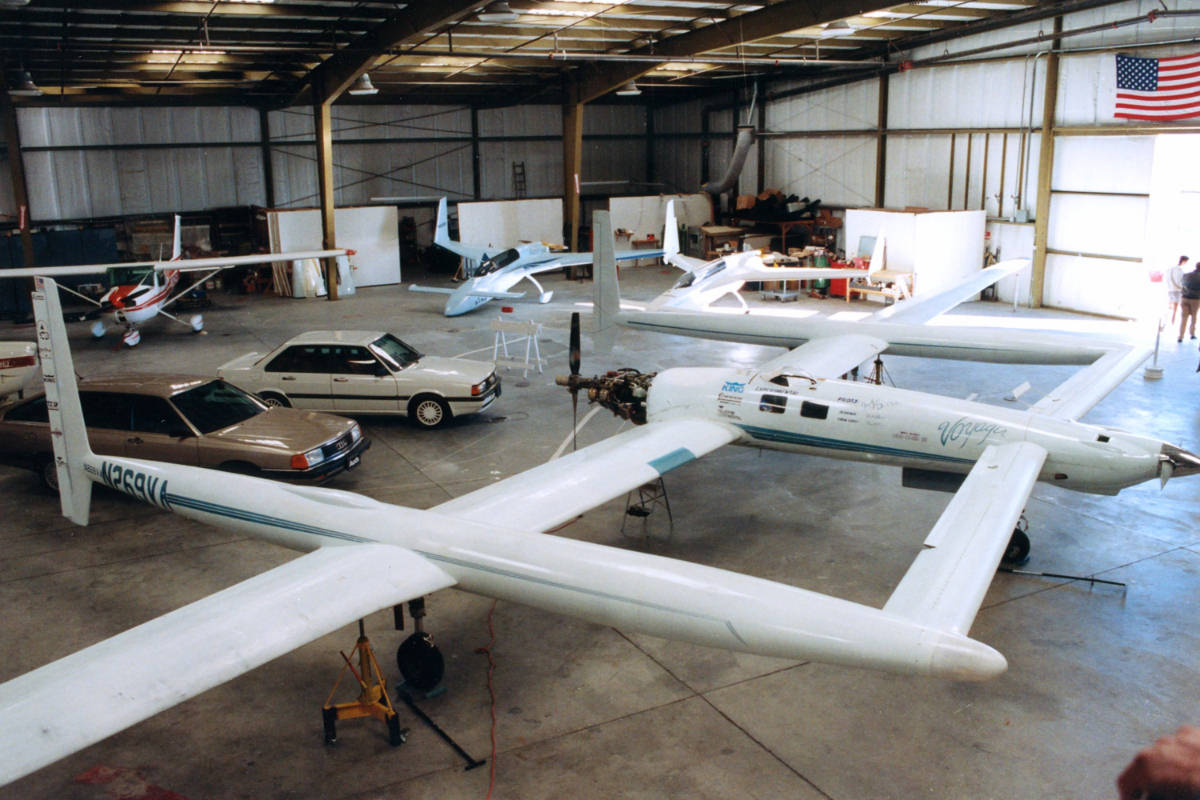
Inside a spacious hangar, the Rutan Voyager sits low and long, its slender fuselage and outsized wings filling the frame like a glider built for endurance rather than speed. Twin propellers bookend the aircraft’s unusual layout, and the polished white surfaces catch the industrial light spilling in from the open door. Nearby cars and smaller planes offer an immediate sense of scale, underscoring just how purpose-built this machine was for a marathon in the sky.
What made the Voyager’s nonstop, unrefueled flight around the world so astonishing was the discipline of weight, aerodynamics, and reliability—every curve and component had to justify itself. The photo hints at that mindset: minimal excess, long spans, and a workshop atmosphere where experimentation meets meticulous preparation. Even without seeing the flight in motion, the aircraft’s stretched proportions and clean lines tell a story of range anxiety solved through inventive design rather than brute force.
For readers drawn to aviation history and breakthrough inventions, this image anchors the legend in a real, working environment—concrete floor, tools, and the quiet before a record attempt. The American flag on the hangar wall adds context to the era’s spirit of engineering ambition, while the Voyager’s name on the side invites a closer look at the craft that helped redefine what “possible” meant in long-distance flight. Together, title and photograph spotlight a milestone in experimental aircraft design and the technology behind a round-the-world journey without rest or refuel.