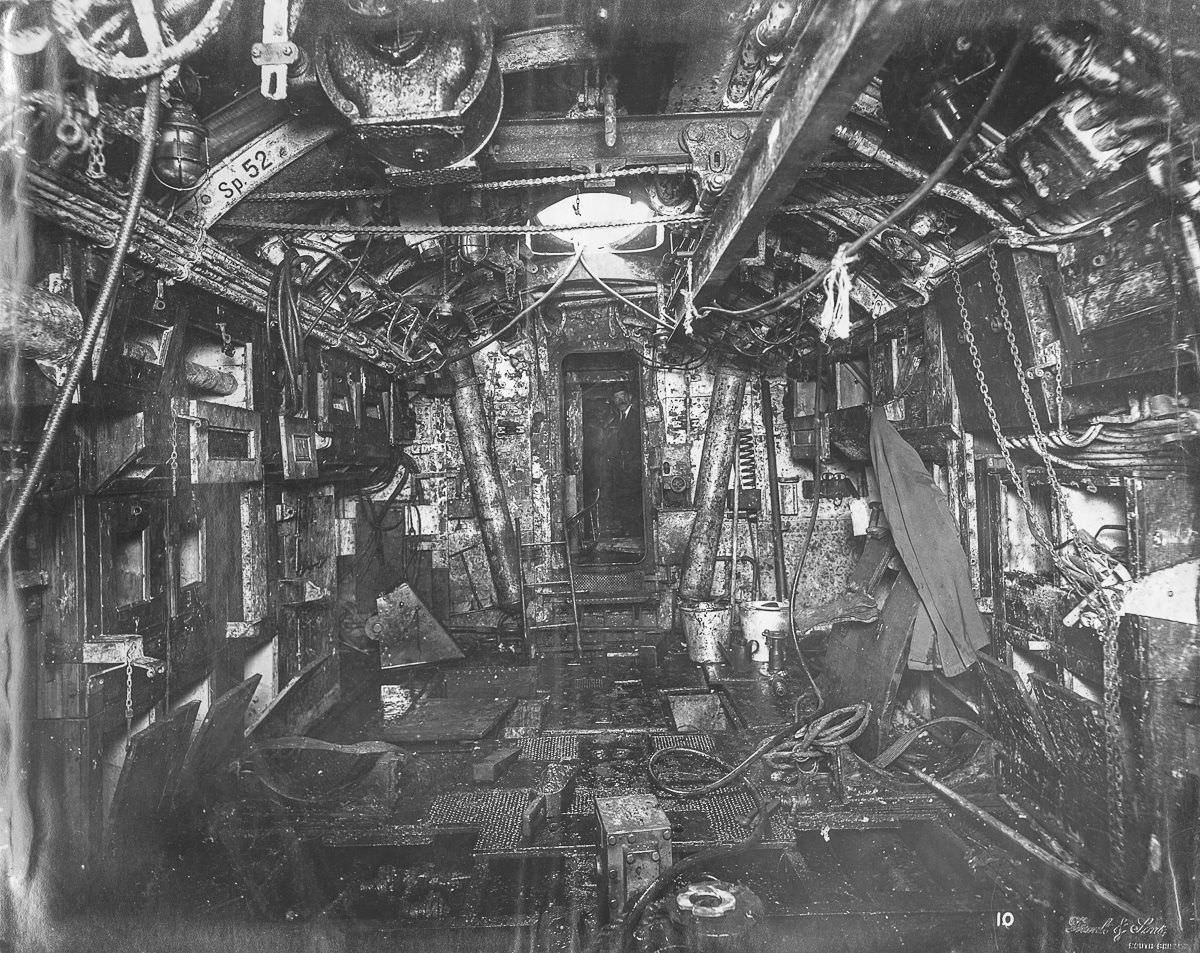
Deep inside a submarine’s hull, the torpedo room looking aft reveals a cramped world of steel ribs, piping, valves, and cables packed into every available inch. The overhead beam mentioned in the title sits like a backbone across the ceiling, engineered to move heavy torpedoes with controlled precision in a space where a misstep could be costly. Harsh lighting glints off worn metal surfaces, suggesting long hours of maintenance and readiness beneath the waterline.
Details in the scene read like a manual of early naval engineering: chains hanging for rigging, handwheels for controlling systems, and gridded deck plates that hint at drainage and traction in wet conditions. The passageway draws the eye toward an aft door, emphasizing how narrow and linear interior movement had to be aboard a fighting vessel. Even without crew in view, the clutter of tools and fittings conveys routine work—loading, securing, checking, and preparing equipment designed for sudden action.
For readers interested in inventions and maritime technology, this photograph offers an unvarnished look at the machinery of undersea warfare and the practical logistics behind it. The lifting beam overhead embodies a simple but vital innovation: turning brute weight into manageable motion with mechanical advantage, all within the constraints of a pressure-tight compartment. As an archival submarine interior image, it complements research on torpedo handling gear, shipboard safety practices, and the industrial craftsmanship that made these vessels operable.