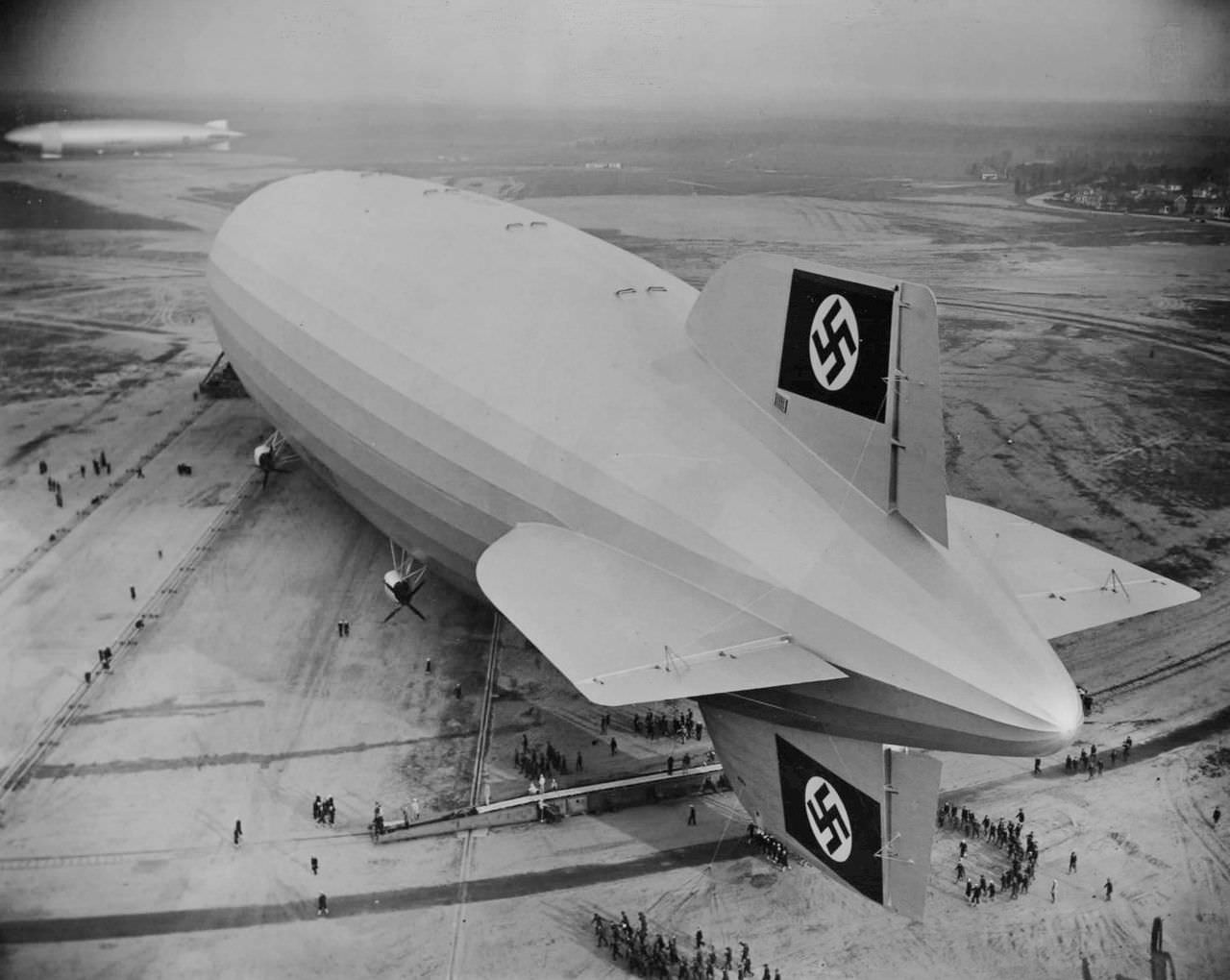
Towering over the airfield like a floating hangar, the German zeppelin Hindenburg rests on the ground with its mooring lines secured and small clusters of people gathered below for scale. The vast, smooth envelope dominates the frame, while the tail fins—marked with Nazi swastikas—make the political context of the 1930s impossible to ignore. In the hazy distance, another airship or aircraft silhouette hangs over the landscape, reinforcing just how unusual and celebrated lighter-than-air travel seemed at the time.
May 9, 1936 marked the Hindenburg’s first landing in the United States, a moment when aviation innovation, spectacle, and international messaging converged on the tarmac. The photograph reads as both engineering triumph and carefully managed public display: ground crews appear dwarfed by the machine, emphasizing the scale of intercontinental air travel then being promised. For anyone exploring early commercial aviation history, this scene captures the era’s optimism about airships as luxurious, long-range transport.
Seen today, the image carries an added weight, because the Hindenburg has become inseparable from the later disaster that helped end the age of passenger zeppelins. Yet this landing is a reminder that before tragedy reshaped public confidence, airship travel was marketed as the future—quiet, grand, and modern. As a historical photo for a WordPress post on inventions and transportation, it offers rich material for discussing aeronautical design, transatlantic travel, and the uneasy intersection of technology and propaganda.