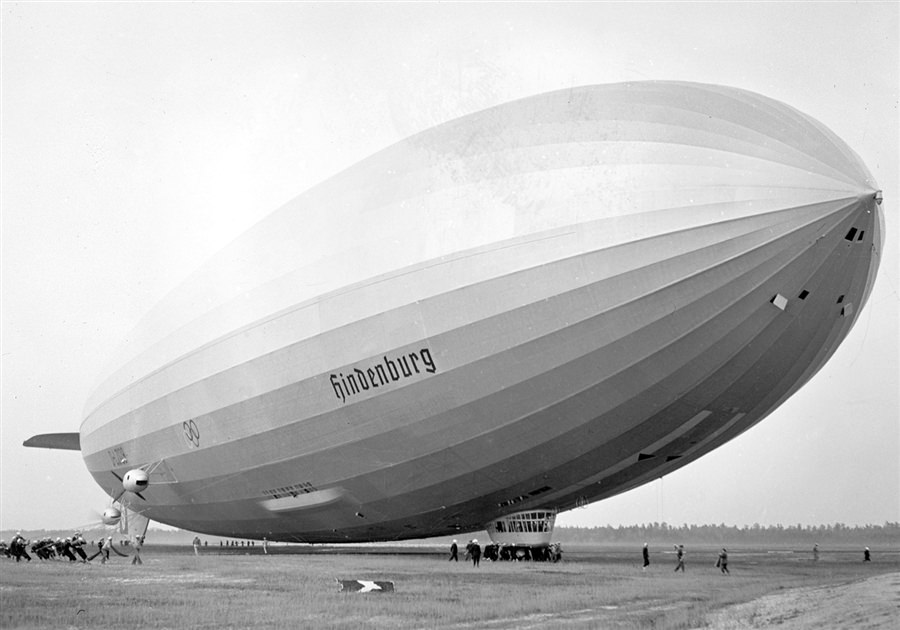
Towering over the open field at Lakehurst, New Jersey, the Hindenburg drifts low as ground crews cluster beneath its vast hull, small figures set against an engineering marvel. The airship’s name is clearly visible along the side, a bold label on a surface that seems to curve endlessly toward the nose. In this moment of approach, the dirigible looks almost weightless, yet the scene below hints at the careful coordination required to bring such a giant safely down.
Ropes trail toward the ground and men move in lines to take hold, turning a landing into a choreographed tug-of-war with wind and momentum. The photograph emphasizes scale: the familiar shapes of people, equipment, and the flat landscape make the ship’s size feel even more astonishing. Details like the gondola and the underside structure pull the viewer into the practical mechanics of airship travel during the 1930s, when lighter-than-air flight promised speed, comfort, and modernity.
Long before the Hindenburg became a symbol loaded with tragedy, it was also an emblem of invention—part luxury transport, part technological spectacle—and Lakehurst served as a key stage for its arrivals. For readers exploring aviation history, early air travel, and the era’s ambitious engineering, this image offers a grounded look at how dirigibles actually operated at the mast and on the field. The quiet tension of the landing attempt lingers here, capturing a world that believed the future could be built in aluminum frames and fabric skins, held steady by many hands.