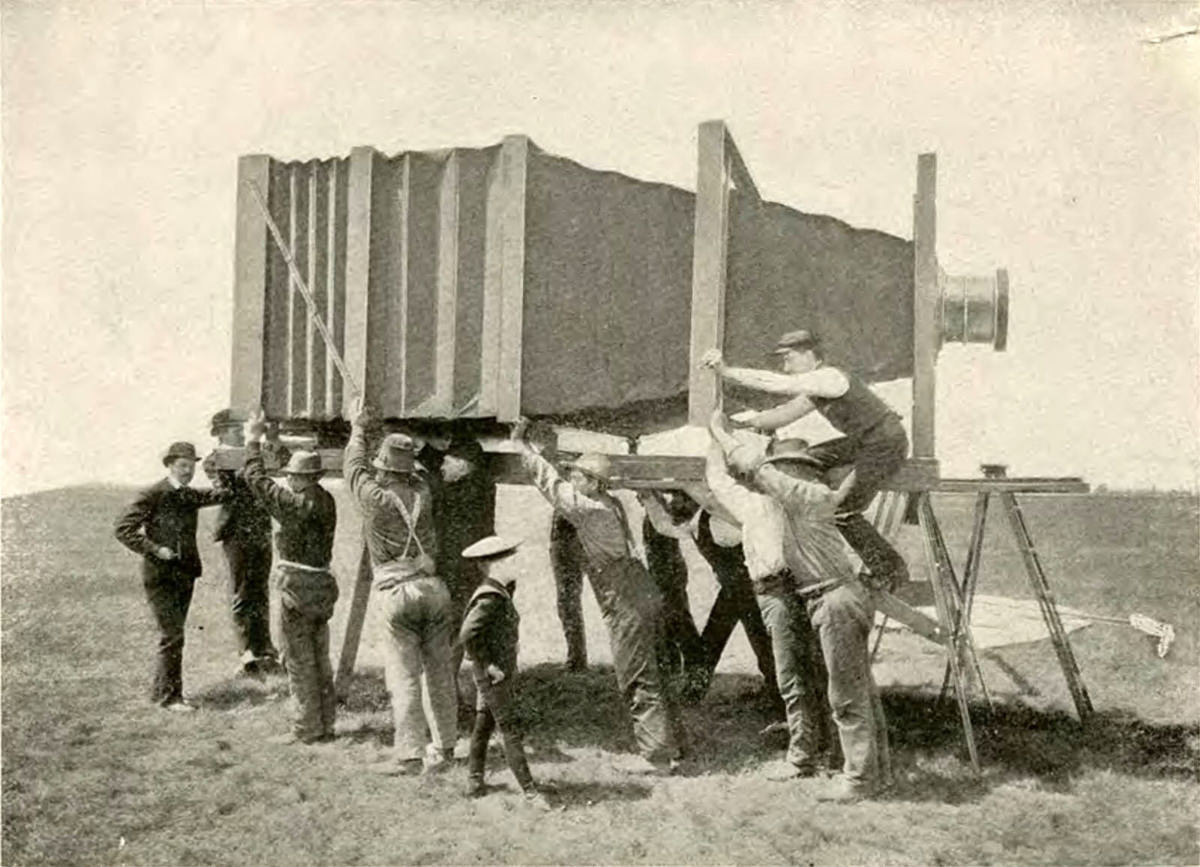
A small crew gathers in an open field around a camera so large it resembles a shed on legs, its long bellows stretched out toward a prominent lens. Several hands grip the wooden frame while one worker climbs up to make a careful adjustment, suggesting the kind of precision that early photographic work demanded. The scene feels part workshop, part expedition—an “inventions” moment where experimentation meets teamwork under the sky.
Adjusting the bellows was not a casual tweak on equipment of this scale; it controlled focus and distance, and any shift had to be steady, measured, and often physically supported. The accordion-like body, rigid rails, and braced supports hint at a period when photographers and technicians built solutions as they went, hauling oversized apparatus into the landscape to get the shot. Even the onlookers, dressed in practical outdoor clothing, underline that this was a technical operation as much as an artistic one.
For readers interested in the history of photography and early imaging technology, the photo offers a vivid reminder of how invention looked on the ground—wood, cloth, metal, and human muscle working in unison. It also speaks to the transitional era when cameras were still closer to machines than personal tools, requiring multiple operators and careful setup before a single exposure. “Adjusting the bellows” becomes a fitting title for a broader story about ingenuity, labor, and the evolving craft behind historical photographs.