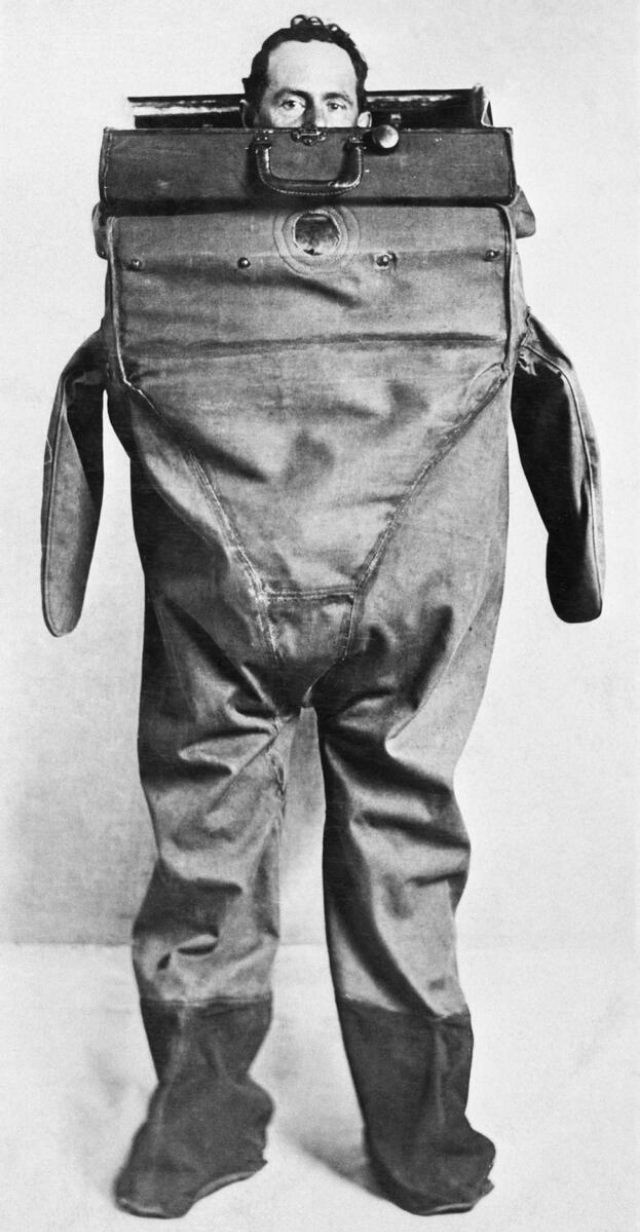
A man stands almost swallowed by an ingenious contraption: an oversized, suitcase-like outfit that rises to his chest, with a rigid top frame, a central circular fitting, and heavy, rubbery fabric falling into full-length legs and enclosed feet. The design reads as part luggage, part protective gear—an early 20th-century attempt to make survival equipment wearable, portable, and ready in an instant. Even in a static studio setting, the sheer bulk of the apparatus hints at the era’s fascination with mechanical solutions to everyday danger.
Linked to the post title, this 1915 invention attributed to John Edlund suggests a bold promise—transforming a traveler’s ordinary carryall into something closer to a personal lifeboat. The visible straps and reinforced seams imply it could be secured quickly, while the stiff upper edge looks built to keep the top open and the wearer afloat or insulated. It’s a striking example of how inventors of the period tried to bridge the gap between convenience and catastrophe, anticipating emergencies before modern safety standards became widespread.
For readers interested in historical inventions, maritime safety, and the quirky ingenuity of early portable survival gear, the photo offers a memorable snapshot of problem-solving in progress. The unsettling, cocoon-like silhouette captures both optimism and anxiety: confidence that technology can save you, and fear that you might need it at any moment. As a WordPress feature, it’s perfect for exploring 1910s innovation, the evolution of lifesaving equipment, and the human stories behind patents that aimed to turn a simple suitcase into salvation.