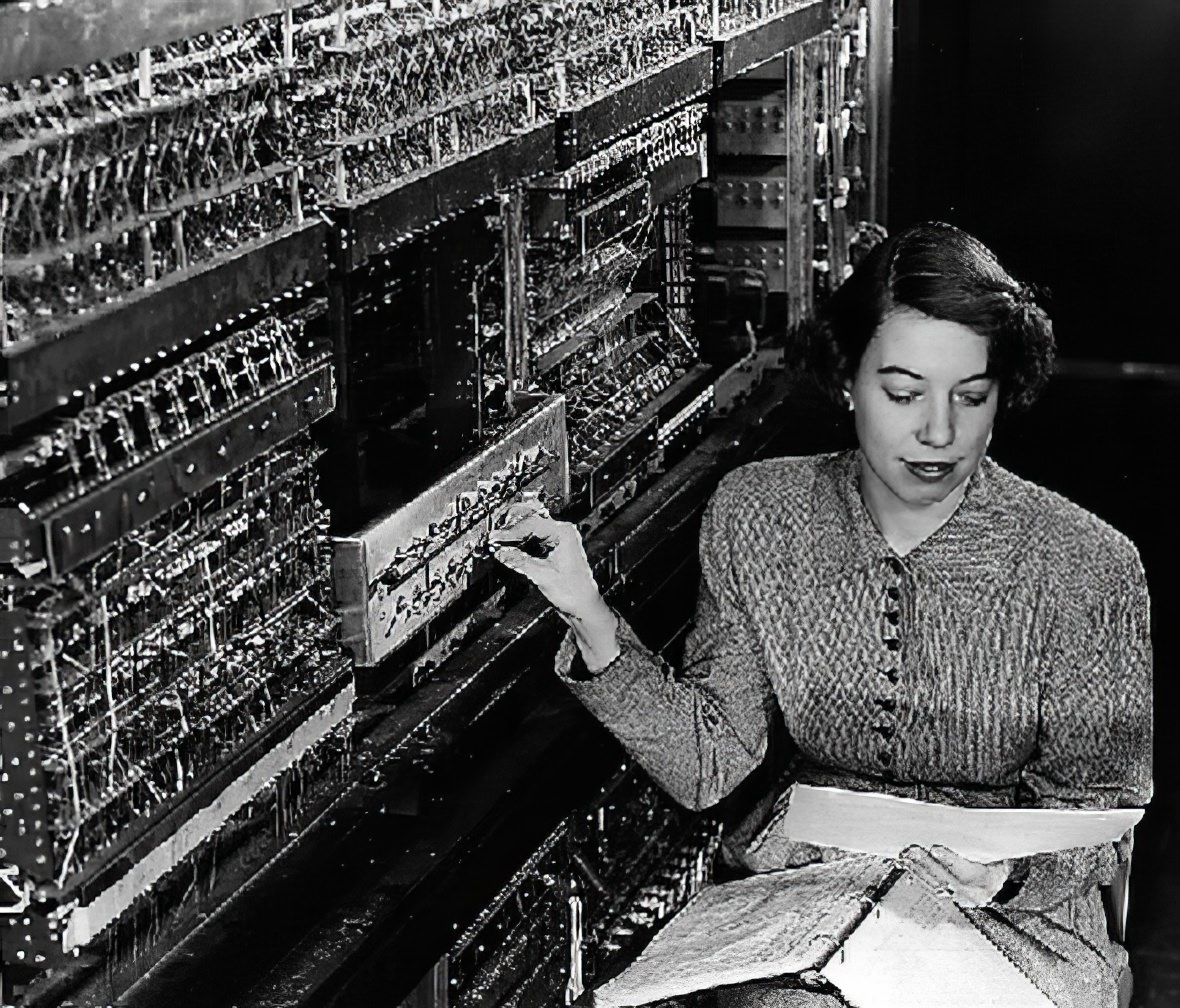
Rows of exposed wiring and component racks stretch across the frame, turning AVIDAC into a kind of industrial tapestry—more laboratory infrastructure than the sleek “computer” most people imagine today. A technician sits close to the circuitry, hand poised at a panel, suggesting the hands-on, physical nature of early digital computing at Argonne. The scene emphasizes scale and complexity: computation as a room-filling machine built from countless connections.
According to the title, AVIDAC began operation in January 1953, placing this moment in the early, formative era of American digital computers. Here, “programming” and “maintenance” blur together, with human expertise literally reaching into the machine’s working parts. The paper in the operator’s lap hints at calculations, run logs, or step-by-step instructions—evidence that these systems demanded meticulous documentation as much as electrical power.
For readers interested in computer history, Argonne history, and mid-century inventions, this photo offers a vivid reminder that breakthrough research depended on both pioneering hardware and the people who kept it running. AVIDAC stands as Argonne’s first digital computer, a milestone on the path from specialized scientific machines to the modern world of everyday computing. The image invites a closer look at the craftsmanship behind early electronics and the patient labor that made digital operation possible.