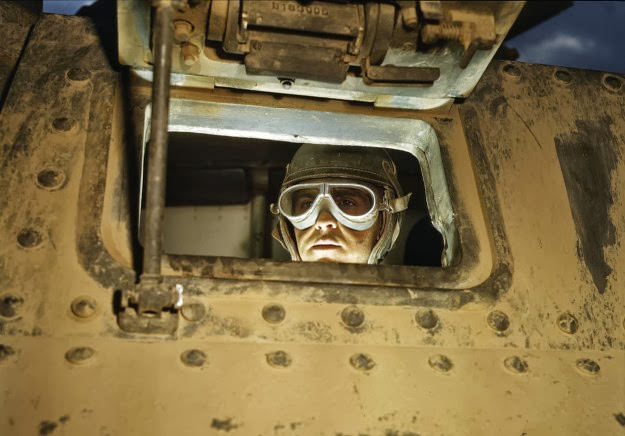
Peering out from a narrow hatch, a tank driver at Fort Knox, Kentucky, fixes his attention on whatever lies ahead, his face framed by riveted armor and the heavy geometry of the vehicle. Protective goggles and a close-fitting helmet hint at the grit, vibration, and flying dust that came with armored training, while the cramped opening underscores how limited visibility could be inside a fighting machine. The colorization brings an immediate, lived-in feel to the scene, emphasizing the worn metal and the practical gear of a soldier preparing for demanding work.
Fort Knox in 1942 was synonymous with the U.S. Army’s rapid expansion and the hard, repetitive drills that turned recruits into tank crews. Inside that steel compartment, every movement mattered—reading signals, judging terrain, and coordinating with others, all while the engine’s roar and the vehicle’s weight shaped each decision. The close-up angle makes the moment intimate, reminding us that behind the mass of American armor were individuals learning to master a new kind of warfare.
Details like the scuffed paint, dust-streaked surfaces, and bolted plates speak to machines that were used relentlessly rather than posed for display. There’s also a quiet tension in the driver’s expression—focused, alert, and partly obscured—capturing the blend of routine and risk in wartime training. For readers interested in World War II history, Fort Knox, and U.S. armored forces, this image offers a striking window into the human side of tank driving in 1942.