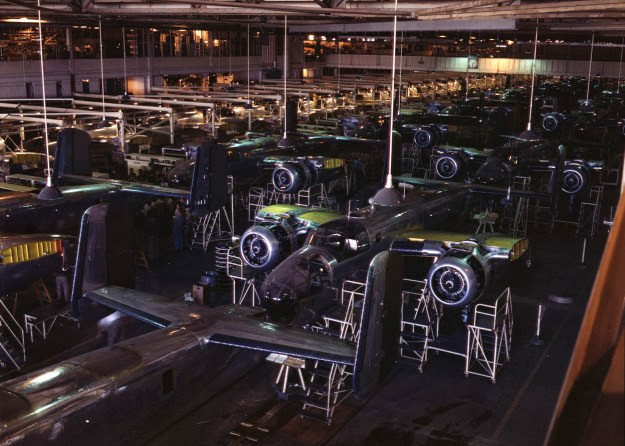
Rows of B-25 Mitchell bombers stretch across the cavernous interior of North American Aviation’s Inglewood, California, plant, their twin engines and broad wings repeating in a rhythm that feels almost architectural. The final assembly line is laid out with an efficiency that’s easy to read at a glance: airframes parked nose-to-tail, work platforms clustered at key points, and overhead lighting casting hard reflections on fresh metal skin. In color, the scene leans less toward romance and more toward industry—an active factory floor built for speed, precision, and volume.
Look closer and the scale of wartime aircraft production becomes the real subject. Scaffolds hug fuselages and engine nacelles, suggesting teams moving from station to station to fit panels, wire systems, and finish assemblies before the aircraft roll onward. Every identical bomber in the frame hints at standardization and interchangeable parts, hallmarks of 1942 manufacturing that turned complex machines into repeatable outputs. Even without people in view, the image conveys motion through its arrangement: a pipeline of aircraft progressing toward completion.
For readers searching for World War II aviation history, the B-25 assembly process, or North American Aviation in Inglewood, this colorized view offers a vivid window into how the home front looked when victory depended on production. The Mitchell was a workhorse bomber, and seeing so many at once underscores how factories became arsenals—less a single airplane being built than a continuous flow of capability being created. It’s a reminder that behind every combat sortie stood acres of floor space, miles of wiring, and the disciplined choreography of an assembly line built to meet the demands of 1942.