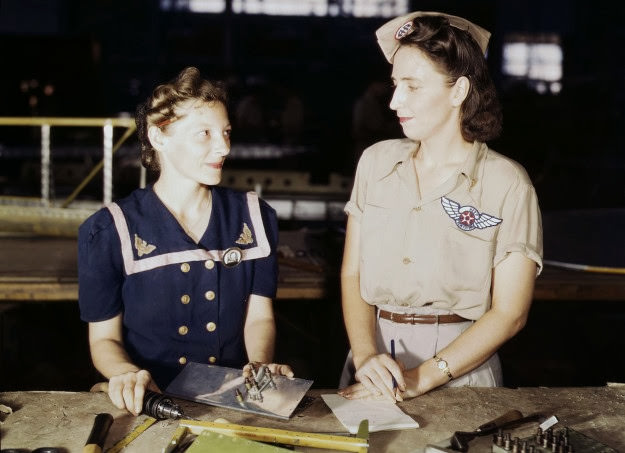
Two women stand at a workbench inside a busy hangar, their attention drawn to the tools and parts laid out before them. One wears a dark, buttoned uniform dress; the other is in a light service outfit with a winged insignia, suggesting official wartime duty. The colorization adds immediacy—skin tones, fabric shades, and the muted industrial backdrop—pulling modern viewers closer to a moment that might otherwise feel distant.
Set at the Naval Air Base in Corpus Christi, Texas, the scene reflects how World War II reshaped daily life far from the front lines. The title’s mention of Pearl Harbor widows underscores the personal stakes behind wartime labor: women carrying grief while stepping into roles that kept aircraft maintenance and training operations moving. On the table, a small cluster of hardware and paperwork hints at the precision and discipline required in naval aviation support work.
Alongside the human story, the photograph offers a textured look at home-front mobilization—uniforms, shop-floor routines, and the collaborative atmosphere of a military workplace. It’s an especially compelling window into women’s contributions to the U.S. Navy’s aviation effort in 1942, and into Corpus Christi’s place in that vast network of bases and training fields. For readers searching for Pearl Harbor widows, WWII women workers, or Naval Air Base Corpus Christi history, this image anchors those themes in a single, quietly powerful encounter.