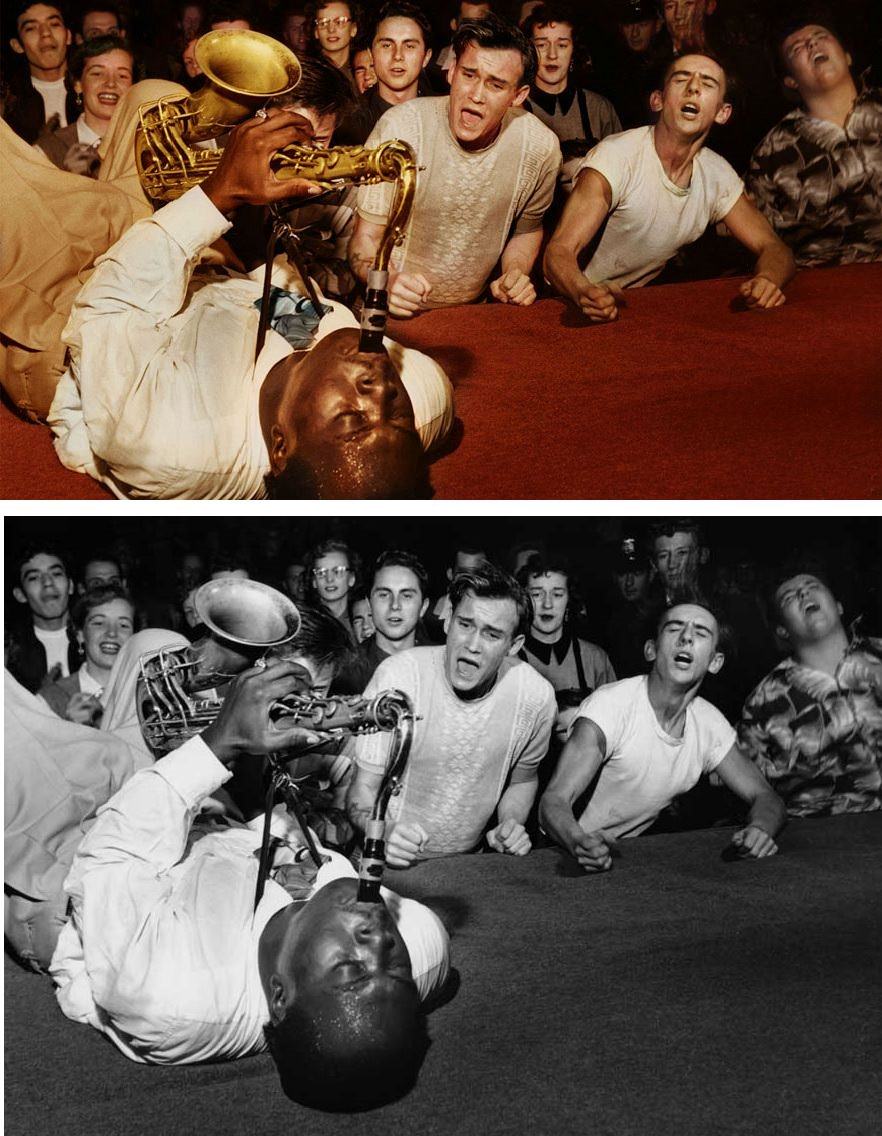
Big Jay McNeely is sprawled on the floor, saxophone raised like a battle standard, turning the Olympic Auditorium into something closer to a prizefight than a concert hall. The crowd leans over the edge with faces wide open—shouting, laughing, singing along—while the horn bell glints under the lights. Sweat, motion, and proximity do the rest, collapsing the distance between performer and audience into a single, roaring moment.
In 1953 Los Angeles, this kind of rhythm-and-blues stagecraft signaled a new entertainment language: louder, bolder, and built on physical electricity. McNeely’s floor-bound solo isn’t a gimmick so much as a declaration that the music belongs to the room, not just the bandstand. The Olympic Auditorium, better known for sporting events, becomes a perfect backdrop for the era’s collision of pop culture, youth energy, and nightlife spectacle.
Colorization adds another layer to the story, emphasizing warm tones in the crowd and the metallic sheen of the sax while preserving the raw drama of the original scene. For readers searching for Big Jay McNeely, Olympic Auditorium history, or 1950s R&B and early rock ’n’ roll performance, this photo delivers an unforgettable snapshot of live music at its most immediate. It’s not just a record of a show—it’s evidence of how a single musician could whip a room into a frenzy with breath, brass, and nerve.