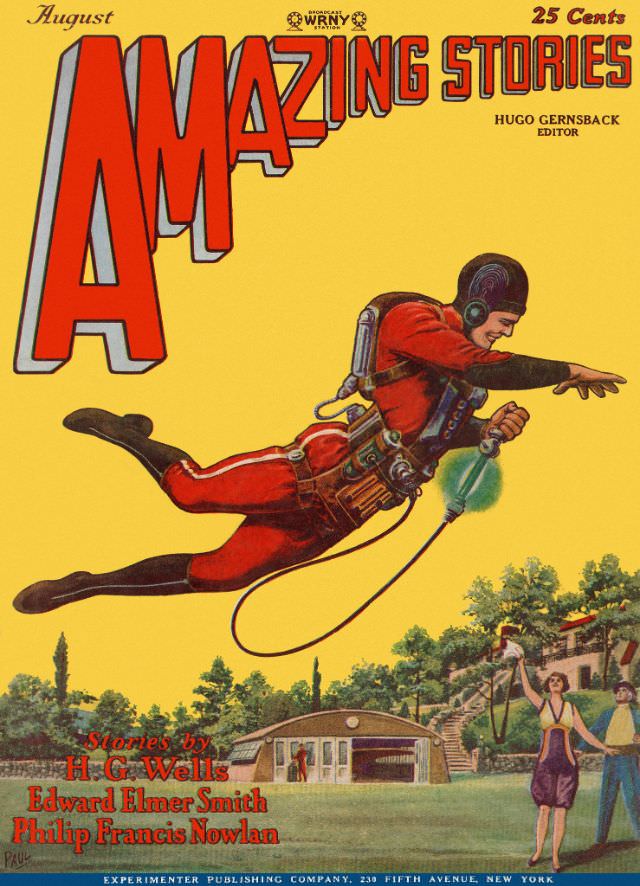
Bold block letters spell “AMAZING STORIES” across a sunlit yellow field, instantly setting the tone for the August 1928 issue’s exuberant pulp imagination. The cover balances clean, poster-like space with a single dramatic action: a red-suited figure streaking diagonally through the air, arms outstretched as if swimming in sky. Small period details—“25 Cents,” “Hugo Gernsback, Editor,” and the publisher line for Experimenter Publishing—anchor the fantasy in the practical world of newsstands and early science-fiction fandom.
At center stage, the airborne character wears a helmet and a compact apparatus on his back, with tubing and a handheld nozzle that suggests a powered flight experiment rather than magic. Below, a manicured lawn, trees, and a low building with steps create a grounded, everyday setting, making the flyer’s movement feel even more uncanny. Two onlookers in 1920s attire glance upward, their calm stance contrasting with the urgency of the figure slicing across the page.
Collectors and readers often return to Amazing Stories cover art for its blend of optimism and mechanical wonder, and this issue is a vivid example of that visual language. The typography and saturated colors emphasize speed, modernity, and spectacle—hallmarks of early pulp magazine design and the emerging identity of American science fiction. For anyone researching vintage magazine covers, Hugo Gernsback-era publishing, or the evolution of sci-fi iconography, the August 1928 Amazing Stories cover offers a striking snapshot of what “the future” looked like on paper.