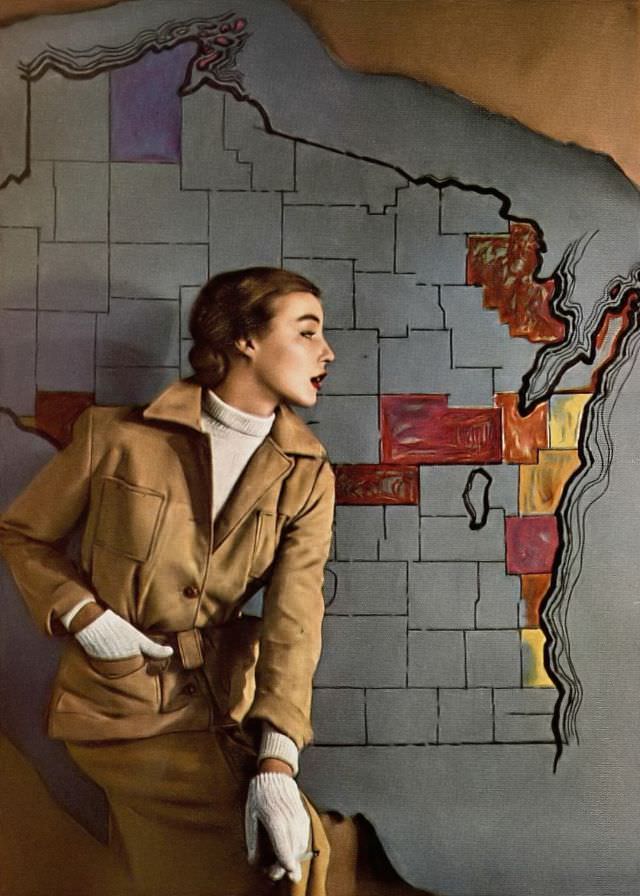
Liz Pringle leans into the frame with a quick, purposeful turn of the head, as if caught mid-stride in an editorial narrative. The camel-colored suede jacket—cut with utilitarian pockets and a cinched waist—sits crisply over a bright white turtleneck, its ribbed cuffs peeking out at the wrists. A matching wool skirt and pale gloves complete the poised, polished look that Harper’s Bazaar favored for modern, city-ready elegance.
Behind her, a stylized map backdrop—readable as the Great Lakes and the Midwest by its shoreline contours and blocky “county” divisions—turns fashion photography into a graphic tableau. The earthy camel tone plays against cool grays and sharp accents of red and ochre, making the outfit’s clean lines stand out while echoing the period’s love of color-blocking and design-forward sets. The composition suggests motion and direction, a postwar mood where travel, work, and confident public presence shaped how clothes were imagined.
Published in Harper’s Bazaar in August 1949, the ensemble credits a Leathermodes jacket paired with a Tilly Schanzer skirt and a Premier cashmere sweater, placing the image squarely in the magazine’s world of named makers and aspirational styling. The overall effect is “beauty in motion” without softness or fuss—structured sportswear refined into high fashion. As a piece of mid-century fashion history, the photograph captures how 1940s silhouettes evolved into the sleek, practical glamour that would define American style in the years ahead.