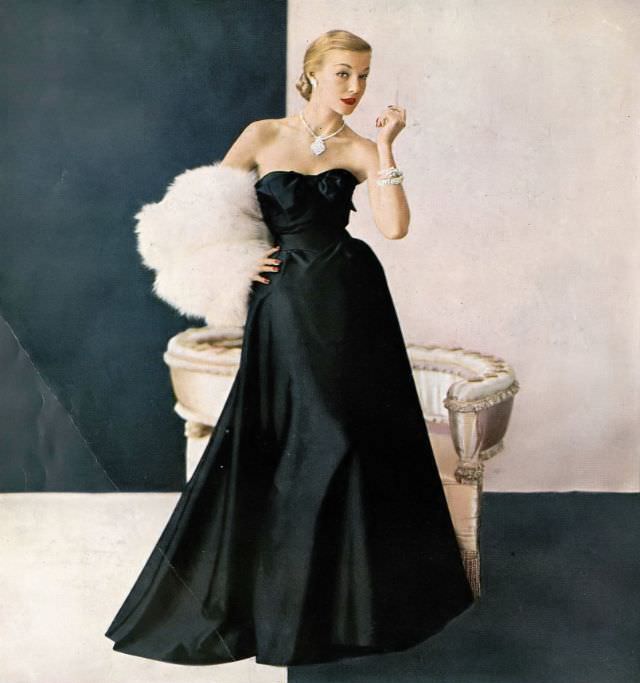
Liz Pringle stands poised in an October 1951 fashion portrait, her strapless evening gown falling in a smooth, sculpted sweep that reads as pure mid-century glamour. The satin faille and Enka rayon fabric catches the studio light with a controlled sheen, emphasizing a fitted bodice and a long, formal skirt designed for grand entrances. Her blond hair is swept back with the neat precision of the era, while a vivid lip and arched brows sharpen the look into classic 1950s elegance.
Against a pared-down set of contrasting dark and pale walls, the styling does the talking: a plush fox fur by Fredrica drapes over one arm, softening the hard lines of the composition with old-Hollywood luxury. A curved, upholstered bench sits behind her, adding a hint of salon refinement without stealing focus from the silhouette. The pose—one hand on the hip, the other lifted in a small, conversational gesture—suggests motion and confidence, as if she’s been caught mid-sentence at an evening affair.
Designer credits turn the scene into a snapshot of fashion culture, with the Maurice Rentner gown paired to Kramer jewelry that glints at the neck and wrist. Together, the materials and accessories map the tastes of early-1950s eveningwear: polished, feminine, and aspirational, balancing modern textiles with traditional fur and statement sparkle. For collectors and researchers, the image offers a clear visual reference for postwar American style—formalwear construction, studio presentation, and the luxe finishing touches that defined high-fashion editorials of the period.