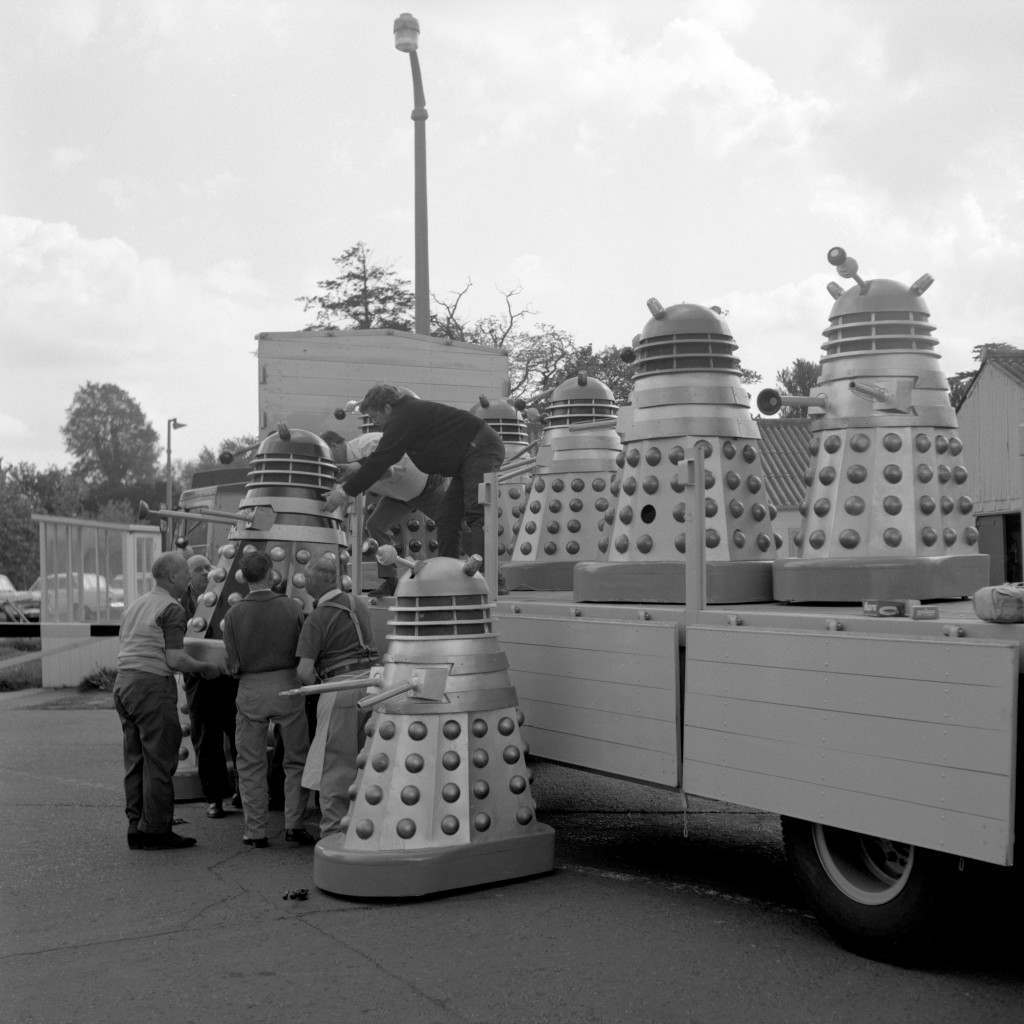
Outside Shepperton Studios in 1965, a flatbed lorry becomes a temporary stage for an unlikely convoy: Daleks lined up in full view, their ribbed casings and studded armour catching the light as technicians cluster around to steady, lift, and secure them. One prop sits on the ground at the tail of the vehicle, while several more rise above the sideboards like a metallic chorus, their eyestalks and dome lights pointing in different directions. The everyday details—work clothes, hands on panels, the studio yard in the background—make the scene feel wonderfully candid, as if the machinery of fantasy has paused in the middle of an ordinary shift.
The title places this moment “en route for the Cannes Film Festival” for *Dr Who and the Daleks*, and that context adds a delightful sense of showmanship to the practical bustle. These weren’t just set pieces; they were inventions built to travel, to be seen, and to represent British screen craft beyond the studio gates. With the Daleks grouped together like export cargo, the photograph hints at how science-fiction design was becoming a promotional spectacle in its own right, bridging workshop ingenuity and international publicity.
For fans of Doctor Who history, film memorabilia, and mid-century special effects, the image offers a rare look at the logistics behind iconic monsters—how they were handled, transported, and prepared for public attention. The Daleks’ unmistakable silhouettes dominate the frame, yet it’s the human activity around them that tells the deeper story: cinema as teamwork, engineering, and careful planning. As a snapshot of 1960s British filmmaking culture, it captures the moment when an imaginative screen invention rolled out into the wider world.