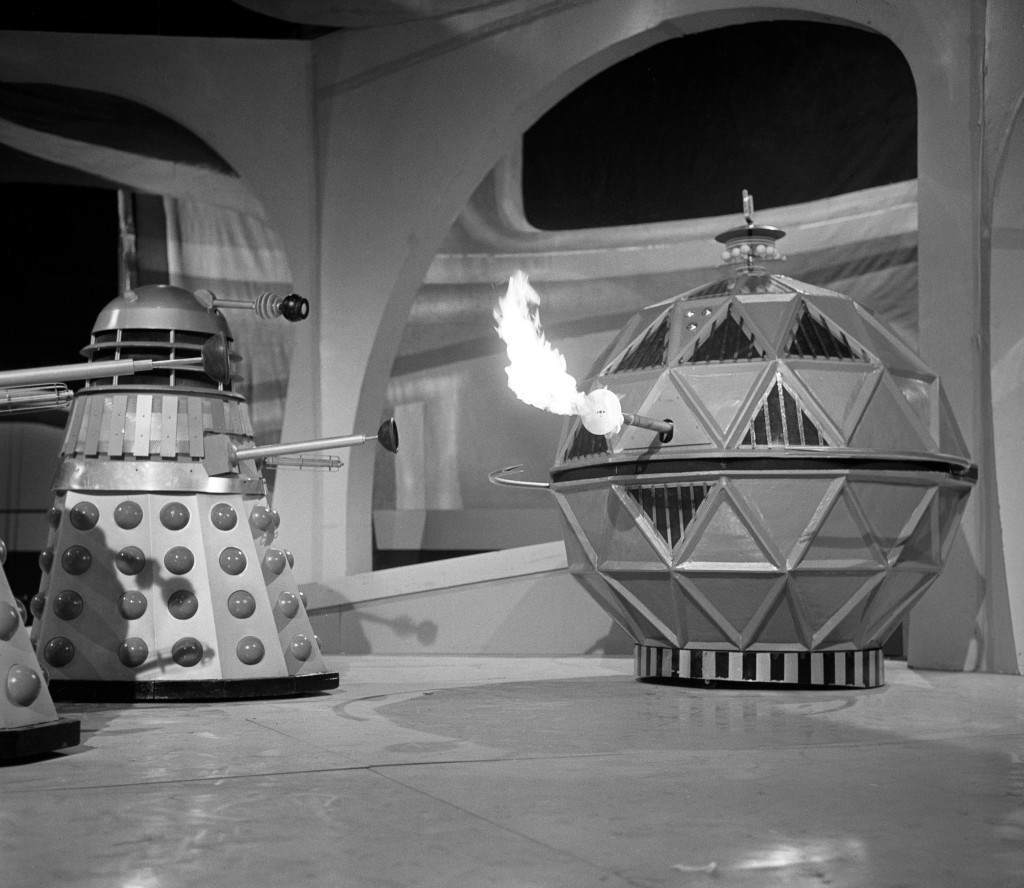
Steel rivets, a domed head, and that unmistakable plunger arm announce the Dalek even before the scene’s tension settles in. Opposite it, a faceted Mechanoid—part spacecraft, part menace—turns the studio set into a small theatre of futuristic dread. The title places us at Ealing Studios in London in 1965, when British science fiction was finding bold, highly visual ways to make the unimaginable feel suddenly close.
What makes this moment sing is the practical ingenuity on display: hard-edged panels, painted surfaces, and stage lighting doing the work of world-building. A burst of flame jets from the Mechanoid’s nozzle, a special effect that would have demanded careful timing and nerves of steel on set. The curved walls and clean, modern lines of the background amplify the “space-age” mood, evoking a controlled, artificial environment where machines rule the frame.
Fans of classic Doctor Who and historians of television production alike will recognise how much craft lies behind such a stark encounter. Long before digital effects, studios relied on inventive prop design and in-camera spectacle to sell danger, speed, and otherworldly technology. As a piece of pop-culture history, this Ealing Studios photograph preserves the era’s imagination in tangible form—an archive of inventions, performance, and British sci‑fi aesthetics at their most confident.