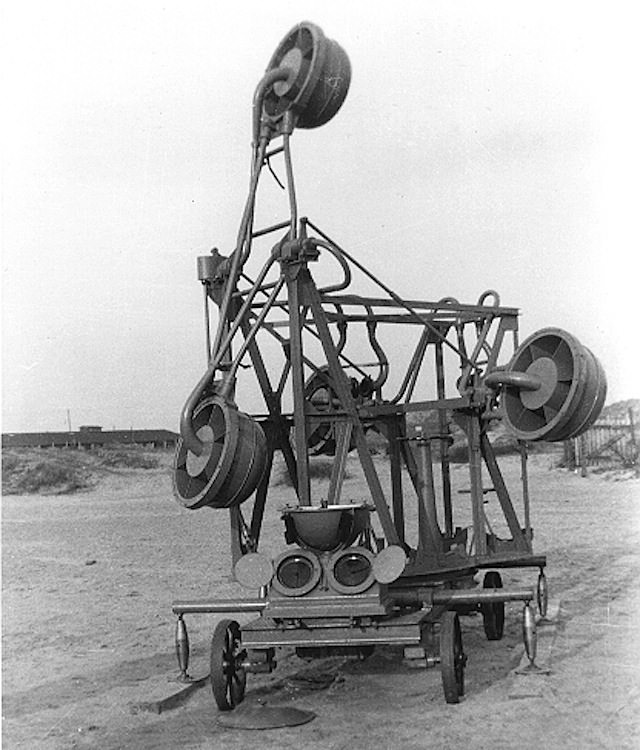
A latticework of metal rises from a small wheeled frame, crowned and flanked by three large circular drums that read like pulleys or flywheels. Cables and rods crisscross the structure, hinting at motion and tension, while a pair of prominent cylindrical housings near the base suggests a power or control unit designed for sustained operation. The overall silhouette feels experimental and purpose-built, the kind of French engineering that prioritizes clever mechanics as much as practical field use.
Barbier, Bénard et Turenne appears in the title as the maker or associated firm, and the photograph invites close study of how such devices were documented in the era of rapid industrial innovation. Set outdoors on bare ground with low buildings in the distance, the scene resembles a test yard or demonstration space rather than a polished showroom. The machine’s compact chassis, stabilizing feet, and high-mounted components point to a design meant to be transported and then deployed on site.
For readers interested in inventions and early mechanical systems, this image offers a vivid look at the materials and design language of its time: riveted frames, exposed linkages, and robust rotating elements that wear their function on the surface. Even without a visible label explaining the exact purpose, the photograph preserves valuable clues about scale, configuration, and intended operation. As a WordPress feature, it makes a strong centerpiece for a post on French industrial heritage, historic engineering devices, and the visual culture of invention.