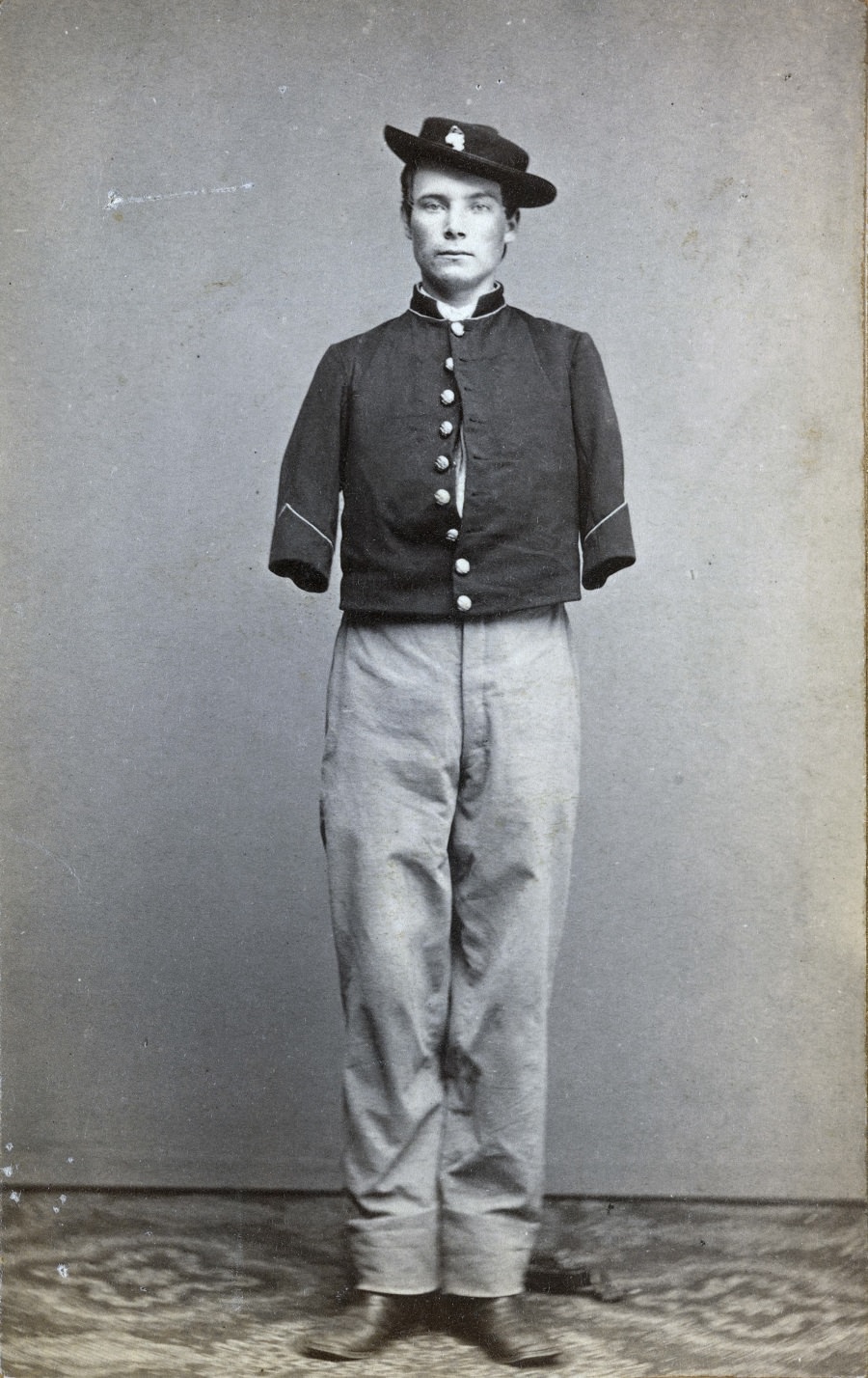
Private William Sergent stands facing the camera in a simple studio setting, his Union uniform buttoned neatly and his cap tilted with a quiet, almost casual confidence. The plain backdrop and full-length pose draw the eye to the details of military dress—dark jacket, light trousers, sturdy boots—while also underscoring what the title makes impossible to ignore: he is photographed after the amputation of both arms. His expression is steady, neither theatrical nor softened, a direct human presence amid the starkness of the frame.
Portraits like this belong to the hard record of the American Civil War era, when the camera began to document not only soldiers heading to the front but also the cost carried home on surviving bodies. Sergent’s missing sleeves, cut short and empty, communicate as much as any battlefield scene, reminding viewers that “in uniform” did not always mean unbroken or unscarred. The photograph’s stillness—no props, no dramatic gestures—lets the reality of wartime medicine and injury speak in its own blunt language.
For readers searching Civil War history, Pennsylvania infantry regiments, or the lived experience of wounded veterans, this image offers a powerful entry point into the era’s everyday heroism and aftermath. It invites questions about recovery, disability, and the ways families and communities adapted when young men returned altered by war. Above all, it preserves the individual story of a soldier of Company E, 53rd Pennsylvania Infantry Regiment, rendered with the sober clarity that makes historical photographs so enduring.