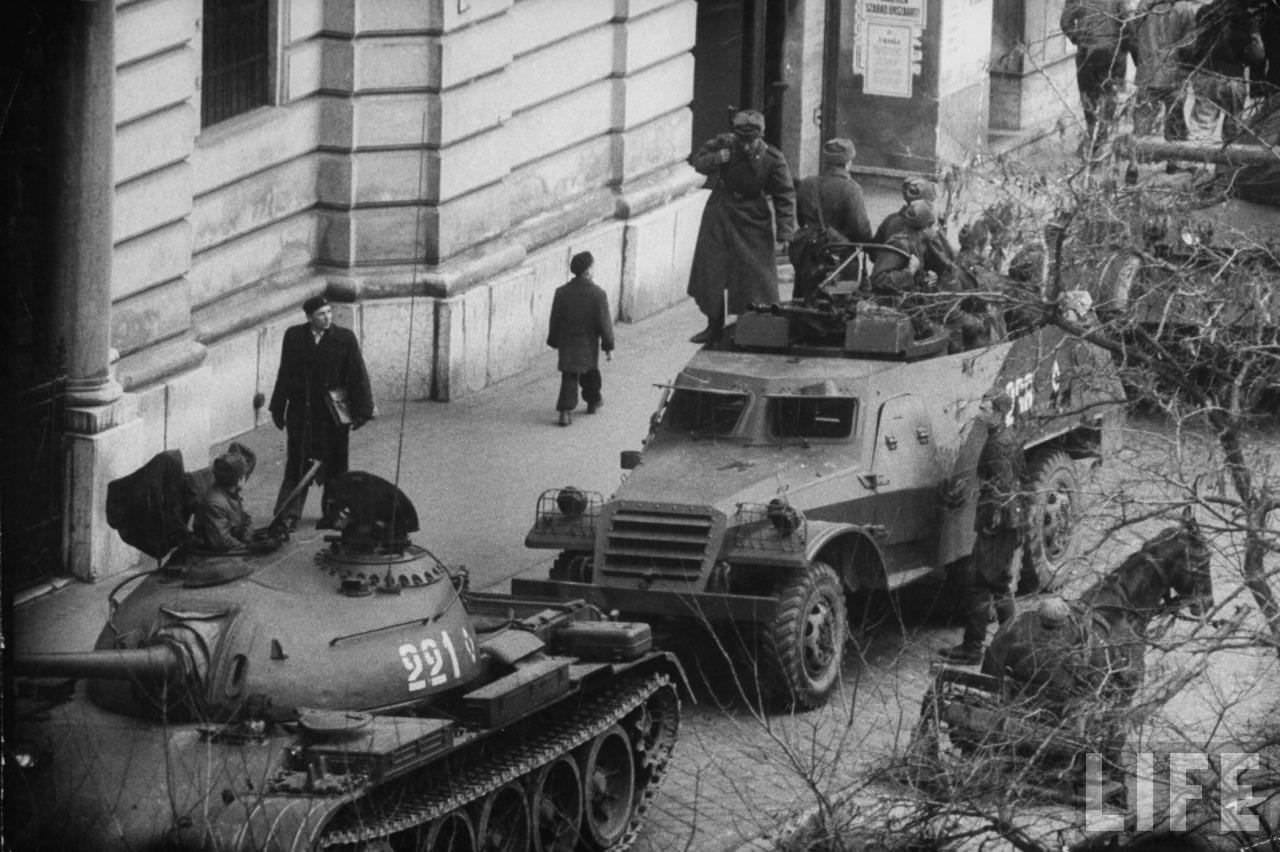
Armored vehicles crowd a Budapest street, pressing close to the heavy stone façade of a city building as soldiers ride exposed on steel and scan the sidewalks. A tank with a painted turret number leads the line, while an armored car follows behind, its wheels wedged against the curb as if the city itself has narrowed into a corridor. The scene feels tense but strangely ordinary at ground level—pedestrians and uniformed men share the same pavement, separated only by the looming presence of military power.
Budapest appears here as a contested urban landscape in the aftermath of an attempted revolution against a Soviet-backed regime, when control of intersections and public institutions mattered as much as open battlefields. The photograph’s tight composition emphasizes occupation and proximity: tracks and tires nearly touch the building’s steps, and bare branches frame the vehicles like barricades made by winter. Details such as the open hatches, the bundled uniforms, and the watchful posture of the troops suggest a moment of consolidation rather than motion—an armed pause in a city still trying to breathe.
For readers exploring Cold War history, civil wars, and the Hungarian uprising, this image offers a stark reminder of how quickly political conflict becomes a physical presence on ordinary streets. It captures the uneasy overlap of civilian life and military enforcement, where architecture, sidewalks, and doorways turn into strategic terrain. Russian tanks in Budapest remain a powerful symbol of the era’s struggle between national self-determination and Soviet authority, and this photograph preserves that friction in a single, unforgettable frame.