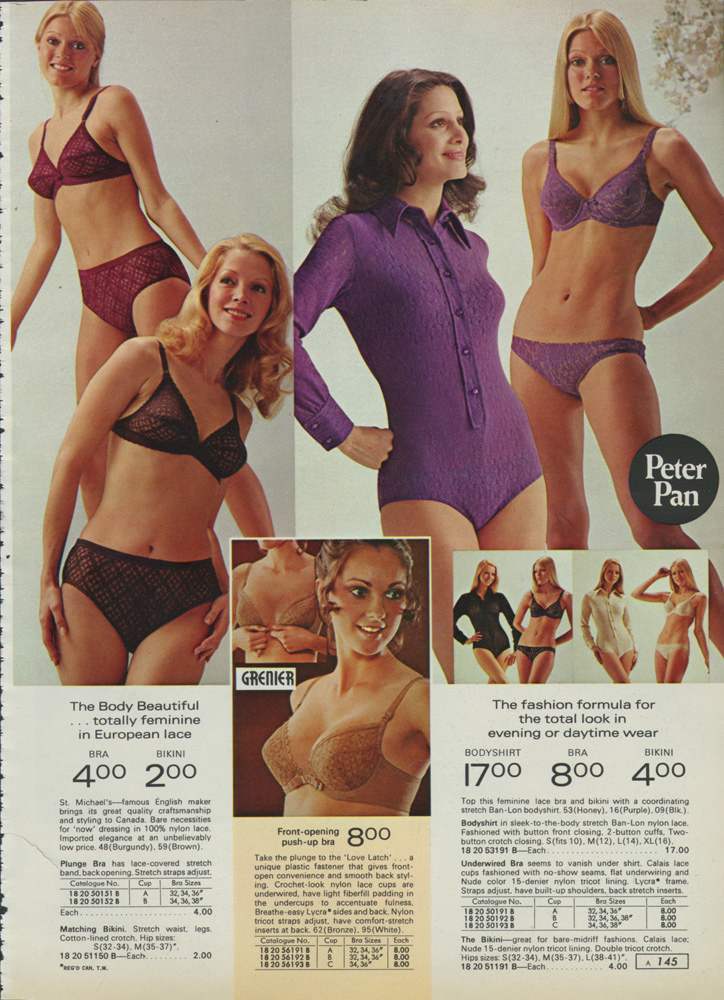
Flip through this 1972 women’s fashion catalog page and the era’s obsession with purple practically leaps off the paper, from a long-sleeve bodysuit to coordinated lingerie sets in jewel-toned lace. Studio-lit and carefully posed, the models present a confident, streamlined silhouette that sits right between late-’60s flirtation and the more practical, mix-and-match wardrobe of the early ’70s. Even the styling—smooth hair, minimal accessories, and clean backdrops—keeps the focus on color, texture, and fit.
Lace is the star fabric here, used to signal “European” femininity while also giving everyday underpinnings a sense of luxury. The catalog copy and pricing blocks underline how fashion was sold at the time: bodywear, bras, and bikini-style briefs offered as coordinated options, with small inset images hinting at alternate shades and sets. Brand marks like “Peter Pan” and “Grenier” add to the period authenticity, reminding readers that department-store labels and manufacturers shaped what “fashionable” meant for many households.
Seen as a cultural artifact, this spread speaks to the changing definition of women’s style in the early 1970s—where comfort, bold color, and a modern outline could coexist with traditional ideas of glamour. It’s a sharp snapshot of fall/winter fashion marketing, reflecting the wider trends named in the post title: the pull toward minis and slacks above, and the coordinated foundations beneath. For collectors, designers, and vintage-style enthusiasts, the page offers rich details in typography, color palettes, and lingerie design that anchor it firmly in 1972.