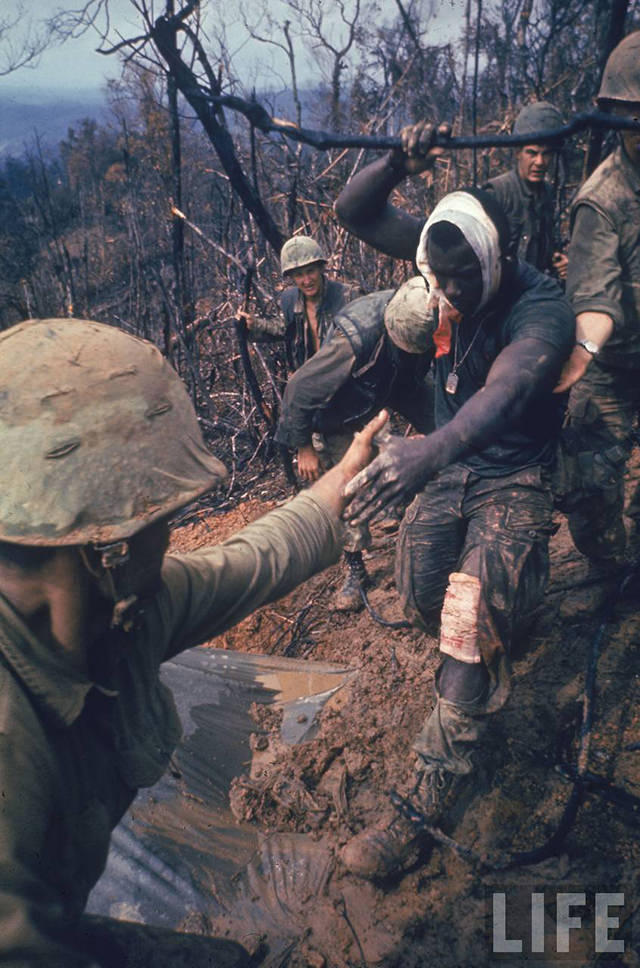
Mud clings to boots and fatigues as a wounded Marine is guided up a slick embankment toward an air evacuation point, his head wrapped in a field dressing and his face streaked with grime. A gloved hand reaches out from the foreground, offering balance at the worst moment of the climb, while other Marines crowd close behind with tense, watchful expressions. The surrounding brush looks battered and sparse, framing a narrow path where every step seems to fight gravity and exhaustion.
In the Vietnam War, evacuation was often a race against terrain as much as time, and the scene underscores how quickly a patrol’s mission could turn into an urgent medical rescue. Bandages, improvised support, and steadying grips tell their own story of combat medicine in the field—care delivered under pressure, with limited supplies and no guarantee of safety. The airlift destination remains off-camera, yet the urgency is visible in the forward motion and the way the group moves as a single unit.
What lingers is the human choreography of survival: one Marine pulling, another bracing, others scanning the slope, all focused on getting their injured comrade to a place where a helicopter can take over. For readers searching Vietnam War photos, US Marines in Vietnam, or battlefield evacuation history, this image offers a grounded, intimate look at what “medevac” meant on the ground. It’s a reminder that behind every evacuation statistic were bodies weighed down by wet earth, and bonds tested and proven in the worst conditions.