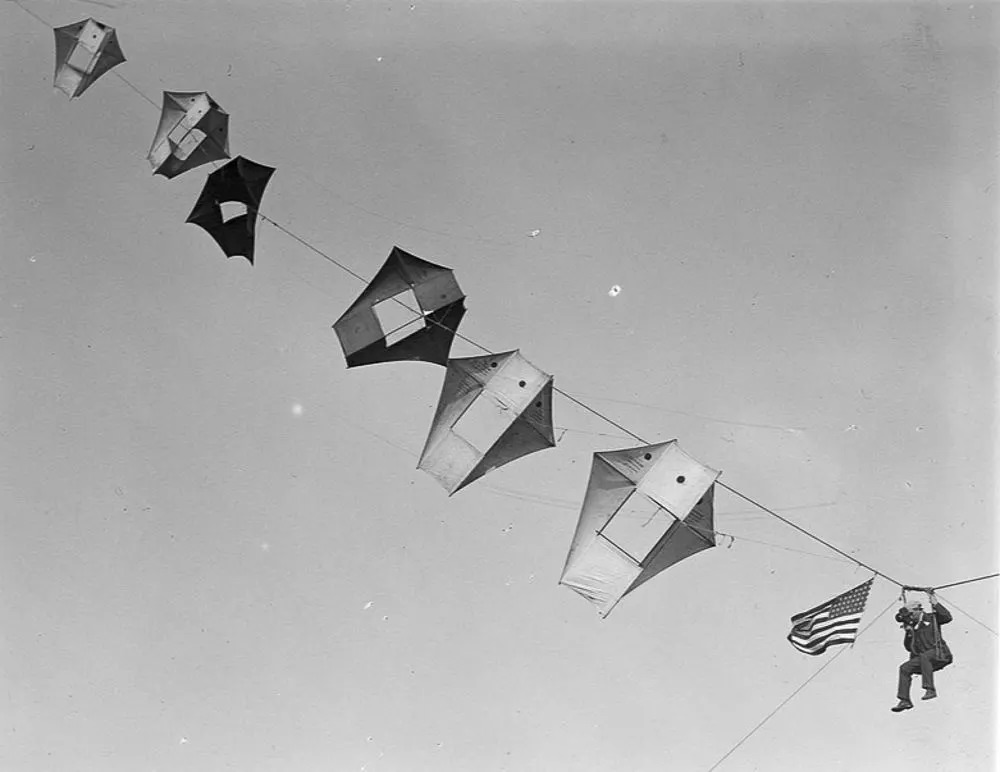
A string of boxy kites marches diagonally across an open sky, each cell tugging the line taut as if it were part of a single flying machine. At the far end, a person hangs in a harness beneath the kite train, legs bent and body angled into the wind, while an American flag flutters nearby on the same rigging. The stark simplicity of the scene hints at a time when lift came not from engines, but from fabric, spars, and careful balance.
Man-lifting kites were more than daring stunts; they were practical experiments in aerial reconnaissance before aircraft became reliable and widespread. By stacking multiple kites in series, operators could generate steadier lift and greater height, raising an observer above the ground to scan terrain, spot movements, or relay signals. The photo’s repeating geometric frames make that engineering logic visible—distributed pull, shared load, and a modular approach to climbing into the air.
Wind-powered observation reads like a forgotten branch of military and invention history, yet it sits squarely on the path toward modern surveillance technology. The human figure suspended beneath the line underscores both the promise and the peril: a cheap “aerial platform” that depended on weather, skill, and nerves. For anyone searching the history of man-lifting kites, early aerial scouting, or pre-airplane reconnaissance, this image offers a vivid reminder that the sky was being used long before powered flight made it commonplace.