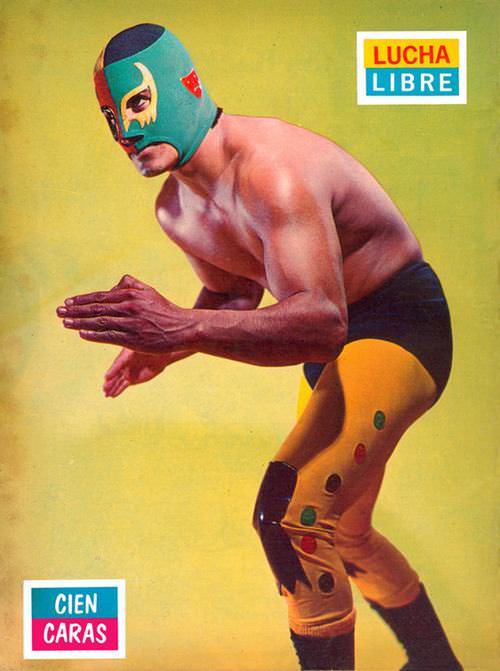
A masked luchador crouches in a ready stance against a bold yellow backdrop, his hands poised as if the next hold is only a heartbeat away. The green mask—trimmed with red accents—frames an intense gaze, while the streamlined black-and-gold tights keep the focus on athletic form and theatrical flair. In the corner, the “LUCHA LIBRE” logo and the striking “CIEN CARAS” text anchor the design like a promise of drama inside.
Cover art like this helped turn lucha libre magazine covers of the 1970s into a vivid storefront for Mexican wrestling culture, where color and character mattered as much as the bout itself. The minimal background, strong contrast, and poster-like composition elevate the wrestler into an icon, more superhero than sportsman. Even without a ring in view, the stance and styling tell a story of rivalry, spectacle, and the rituals of the mask.
“Blood, Masks, and Glory” is an invitation to read these covers the way fans did—like snapshots of mythmaking, packed into a single frame. For collectors, designers, and wrestling history enthusiasts, the image offers a clear look at the era’s graphic language: clean typography, saturated color, and a star presented front and center. It’s a reminder that lucha libre cover art wasn’t just advertising; it was part of the performance, preserving the aura of the masked hero for the newsstand and beyond.