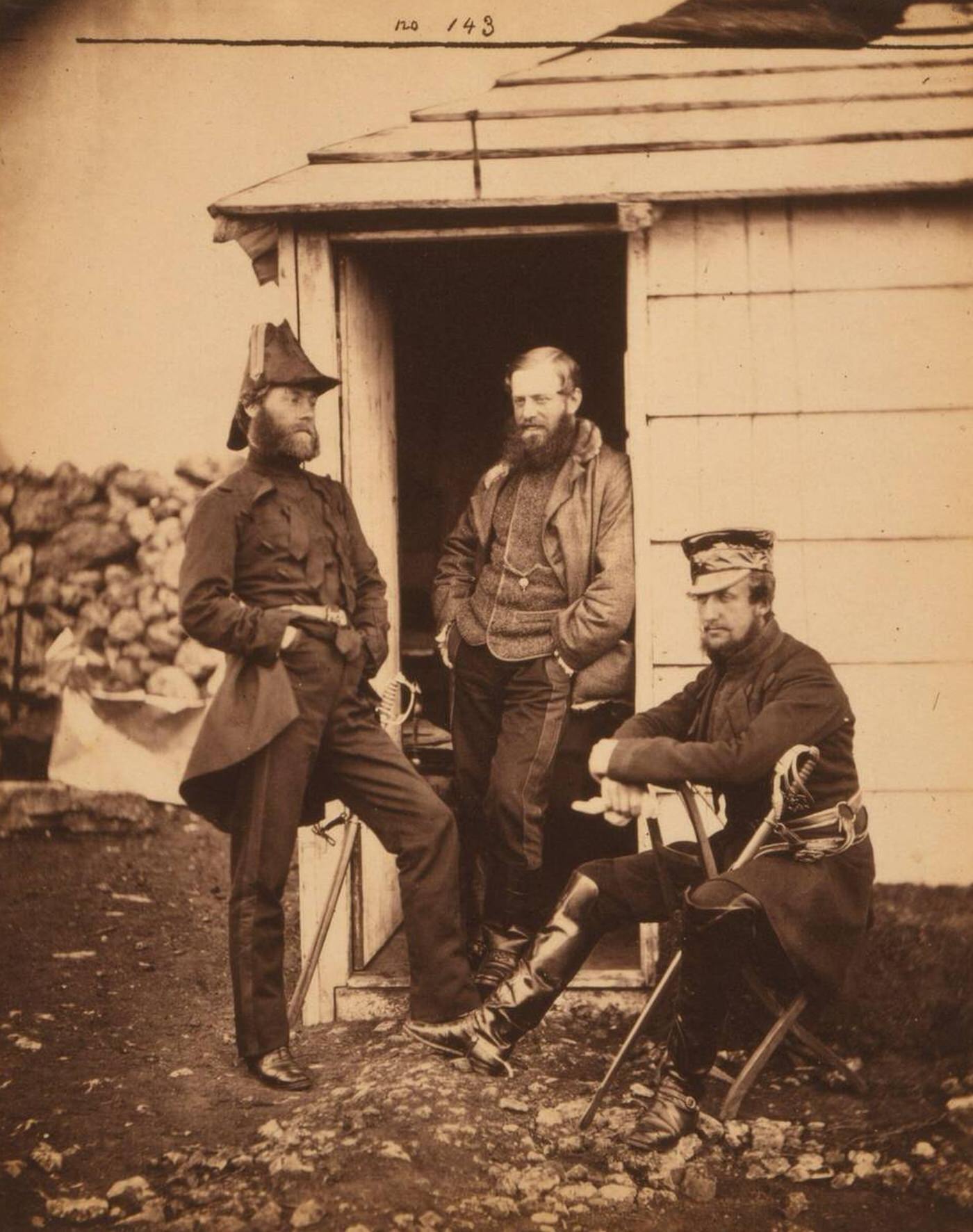
Three British officers—identified in the title as Captains Ponsonby, Pearson, and Markham—pose with an unguarded confidence beside a plain wooden hut during the Crimean War in 1855. One stands at ease with hands in his pockets, another fills the doorway like a weary host, and the third sits forward, sabre at his side, meeting the camera with a steady gaze. Their dark uniforms, polished boots, and varied headgear create a striking contrast with the rough ground and the improvised feel of the shelter behind them.
Details like the sword hilts, belts, and the cut of the coats hint at the daily routines of staff officers—men tasked not only with courage under fire, but with coordination, orders, and the relentless paperwork of an army in the field. The setting reads as functional rather than ceremonial: a threshold between the private world of a cramped quarters and the exposed landscape of a campaign. Even without battlefield action in view, the portrait carries the tension of service, suggesting long hours, cold weather, and the constant proximity of danger.
As a piece of Crimean War photography, this image offers more than a record of faces; it preserves a moment in the mid-19th-century military experience when the camera began to follow armies and fix their realities in public memory. For readers interested in British military history, wartime life, and the material culture of officers’ dress and equipment, the photograph rewards a close look at posture, expression, and surroundings. It is a quiet, human-scale counterpoint to the grand narratives of strategy and siege—three men, a makeshift building, and a war pressing in just beyond the frame.