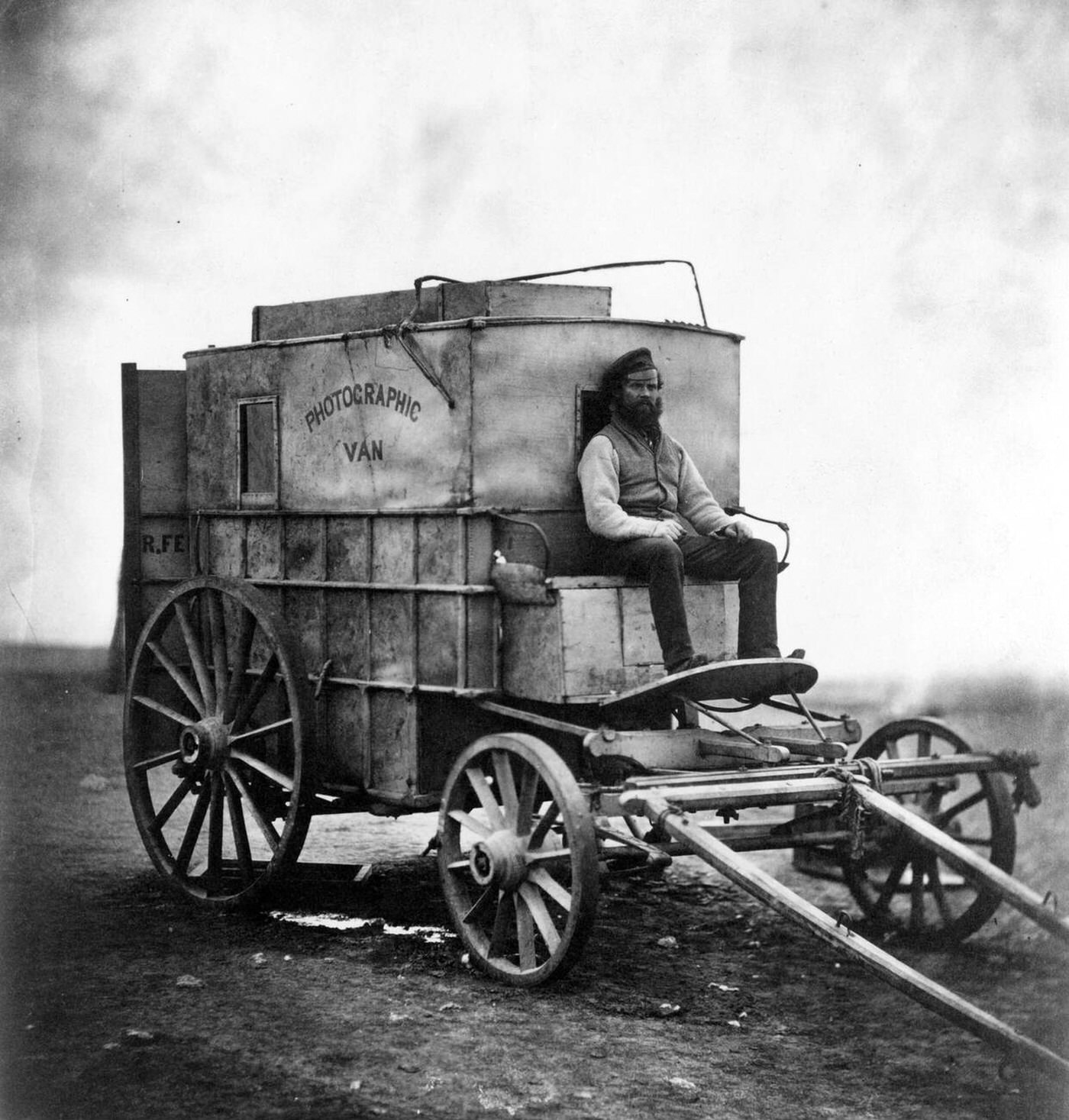
Parked on bare ground beneath a wide, empty sky, a stout wagon labeled “PHOTOGRAPHIC VAN” becomes a reminder that early war reporting depended as much on carpentry and chemistry as on courage. The vehicle’s plank-sided body, tall wheels, and extended shafts suggest a mobile workshop built to follow an army’s pace, carrying fragile glass plates and the materials needed to turn a battlefield into a record. In the Crimean War, Roger Fenton’s camera work helped shape how distant audiences imagined modern conflict, and this rolling darkroom was the unsung engine behind that achievement.
Marcus Sparling, Fenton’s assistant, sits on the front step with the steadiness of someone used to waiting—waiting for light, for orders, for the moment when preparation becomes exposure. His practical dress and composed posture fit the laborious routine of mid-19th-century photography, when negatives had to be prepared, exposed, and processed quickly before they dried. The van’s confined interior would have hosted that race against time, mixing solutions and handling plates while the war carried on outside the frame.
Details like the hand-painted lettering and the rough, utilitarian construction make this image a rich artifact for anyone interested in Crimean War history, early photojournalism, and the origins of documentary photography. More than a portrait of equipment, it hints at the logistics behind iconic images: the transport, the setup, and the skilled assistant who kept the workflow moving. For readers exploring Victorian-era wars and military photography, this scene places the technology of the 1850s right where it belonged—on wheels, close to the action, and always at the mercy of weather, terrain, and time.