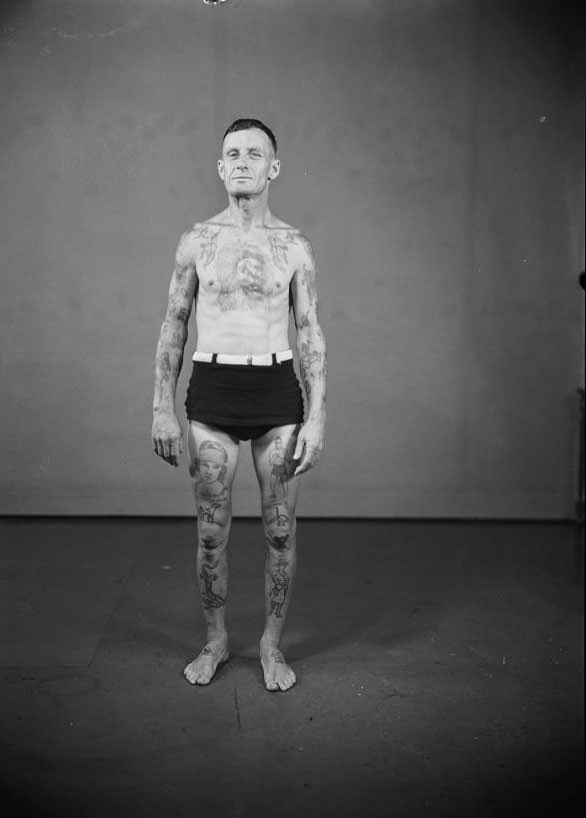
Standing against a plain studio backdrop, John Hennington of Woronora, Australia, faces the camera with a steady, almost formal composure on 25 December 1937. Dressed simply in dark shorts and a light belt, he becomes a living gallery for body art at a time when tattooing was still widely treated as a curiosity or a marker of particular trades and subcultures. The photographer’s straightforward, full-length pose invites close attention to the ink rather than to props or scenery.
Across his chest, arms, and legs, the tattoos form a dense patchwork of figures and motifs, some shaded and portrait-like, others more emblematic and linear. The contrast of pale skin and dark ink reads clearly in the monochrome tones, making each design feel both personal and public—an autobiography worn on the body. Even without knowing the stories behind each image, the arrangement suggests years of accumulation, memory, and identity layered over time.
For readers interested in Australian social history, tattoo culture, and rare studio documentation of body art, this photograph offers a vivid window into the late 1930s. It also works as an “artworks” record in the most literal sense, preserving designs that might otherwise have been lost to time. As a historical photo tied to a specific place and date, it adds texture to our understanding of everyday lives—how people chose to present themselves, and what they carried with them in ink.