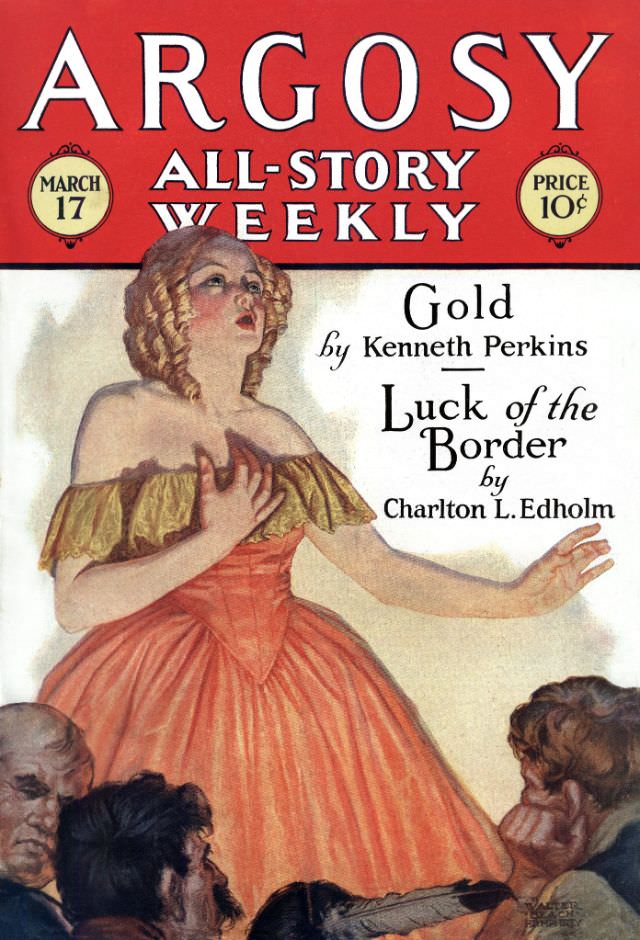
Argosy All-Story Weekly greets the reader with a bold red masthead and the confident typography that defined popular magazine racks of the late 1920s. The cover is clearly marked “March 17” with a price of 10¢, anchoring it in the era when a dime could buy a week’s worth of thrills, cliffhangers, and escapism. As cover art, it’s designed to be read at a glance from across a newsstand—big letters, high contrast, and immediate drama.
Center stage, a woman in a vivid, off-the-shoulder dress recoils with one hand at her chest, her expression caught between shock and resolve. Around the lower edge, several male figures crowd in, their faces turned upward as if pressing a tense moment to its breaking point; the composition pulls your eye from the red header down into the swirl of bodies and emotion. The painterly style, rich color, and theatrical gesture are classic pulp illustration tactics—less about realism than about urgency, danger, and desire.
On the right, story teasers promise adventure with “Gold” by Kenneth Perkins and “Luck of the Border” by Charlton L. Edholm, reminding us how much the cover functioned as a billboard for fiction. For collectors and researchers interested in Argosy magazine covers, pulp magazine art, and early 20th-century popular publishing, this issue offers a concise snapshot of how editors sold narrative excitement through a single frozen scene. Even without reading a line inside, the March 17, 1928 cover signals exactly what Argosy traded in: suspense, sensation, and the irresistible pull of story.