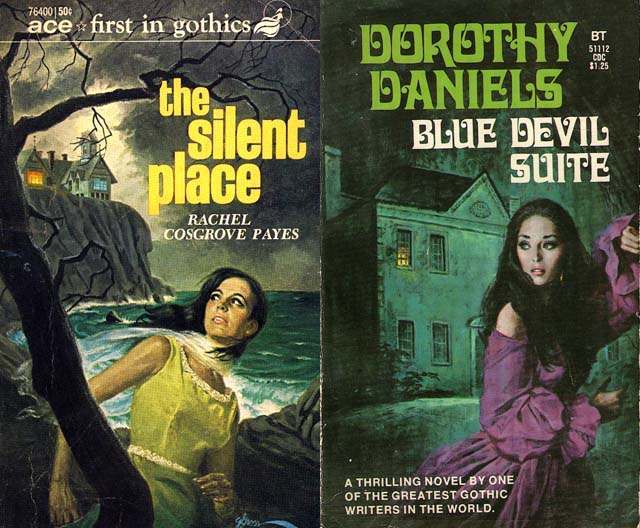
A woman glances back over her shoulder, caught between flight and fascination, while a looming house and jagged shoreline press in around her—an instantly recognizable visual language of gothic romance cover art. On one side, the title “the silent place” sits beside stormy water, twisted branches, and a distant building lit like a warning beacon. The composition funnels the eye from the threatened figure to the architecture, turning the home into an antagonist and the landscape into an emotional weather report.
Across the pairing, “DOROTHY DANIELS” and “BLUE DEVIL SUITE” announce another suspenseful scenario: a mansion-like façade under a greenish cast, and a woman in a dramatic dress clutching fabric as if bracing for a sudden knock at the door. These covers trade in high-contrast color, theatrical lighting, and wide-eyed unease, using the “woman running from the house” motif to sell tension before a single page is turned. Even the typography feels part of the chase, bold and urgent against backgrounds that suggest secrets behind windows and corridors.
Gothic romance readers were drawn to this recurring image because it stages a psychological dilemma as much as a plot hook: escape versus return, dread versus desire, independence versus the pull of the past. The house becomes a symbol—inheritance, memory, captivity, temptation—while the heroine’s half-turned pose invites the viewer to imagine what she has seen and what she fears to discover next. For anyone exploring vintage paperback cover art, pulp illustration, or the history of women-centered suspense, these designs show how a single charged moment could carry an entire genre’s promise.