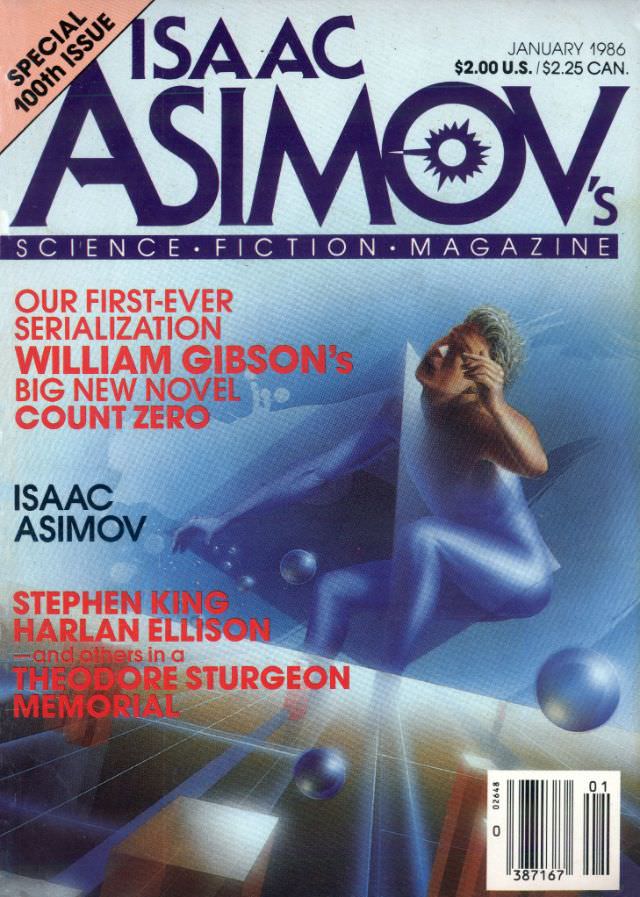
Bold typography dominates the January 1986 cover of Isaac Asimov’s Science Fiction Magazine, framed by a “Special 10th Issue” banner and the crisp pricing line at the top. The masthead’s oversized lettering sets a confident, era-specific tone, while the clean, graphic layout makes the issue’s identity unmistakable even at a glance. For collectors and magazine-history readers, it’s a striking snapshot of how science fiction periodicals presented themselves in the mid-1980s.
Across the blue, futuristic artwork, a curled human figure floats in a cube-like space, surrounded by glossy spheres that feel part physics demo, part dream sequence. The palette leans cool and metallic, with soft gradients and geometric planes that suggest motion, depth, and a near-zero-gravity hush. That blend of the human body with abstract technology cues fits perfectly with the magazine’s promise of ideas-driven speculative fiction.
Front-cover copy highlights major names and a headline that anchors the issue in genre history: the first-ever serialization of William Gibson’s “Count Zero.” Additional cover mentions include Isaac Asimov, Stephen King, Harlan Ellison, and a Theodore Sturgeon memorial, turning the cover into a compact record of what science fiction readers were being sold that month—big voices, memorial tributes, and a sense of the genre’s shifting frontier. If you’re searching for “Asimov’s Science Fiction cover January 1986,” “Count Zero serialization,” or “1980s sci-fi magazine cover art,” this one stands as an iconic reference point.