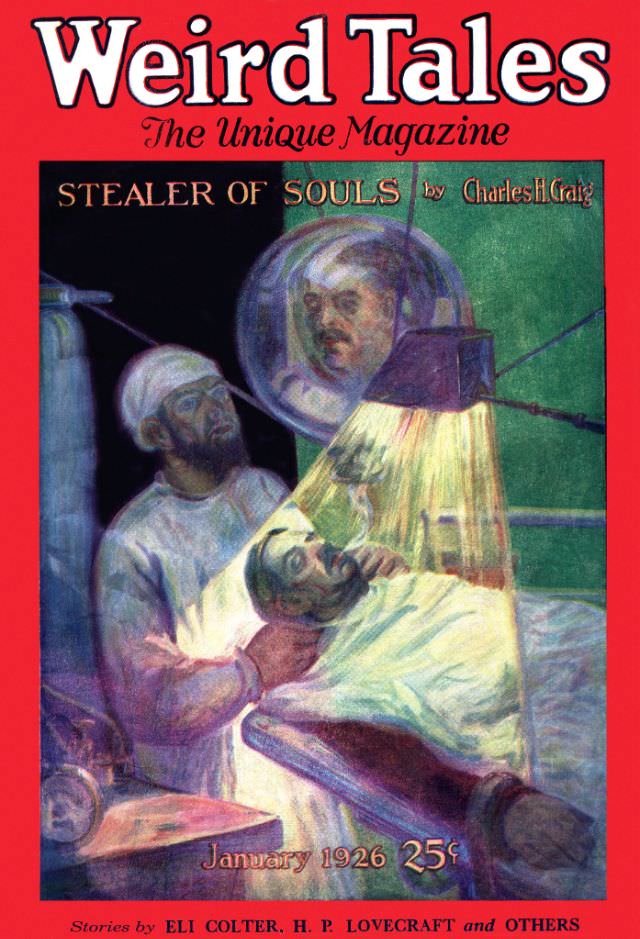
Bold scarlet lettering shouts “Weird Tales” across the top of the January 1926 issue, a classic piece of pulp magazine cover art designed to stop a reader in their tracks. Beneath the masthead, the tagline “The Unique Magazine” promises strangeness, while the story title “Stealer of Souls” appears prominently, framed like a warning over the scene below.
A tense, clinical interior unfolds in moody greens and shadowed blacks: a patient lies swaddled on an operating table under a harsh cone of light, his face turned toward the viewer in alarm. Nearby, a figure in white—part surgeon, part attendant—leans in close, and above them hovers a glassy sphere containing a human head, an uncanny focal point that turns medical equipment into occult apparatus. The lighting and composition play on early twentieth-century fears about surgery, electricity, and the thin line between scientific progress and forbidden experimentation.
Details at the bottom root the artwork firmly in its era, including the “January 1926” date and the “25¢” price, along with the promise of “Stories by Eli Colter, H. P. Lovecraft and Others.” For collectors and fans of classic horror fiction, this Weird Tales cover offers a vivid window into the magazine’s sensational aesthetics—where lurid color, suspenseful staging, and supernatural insinuation worked together to sell weird fiction on the newsstand.