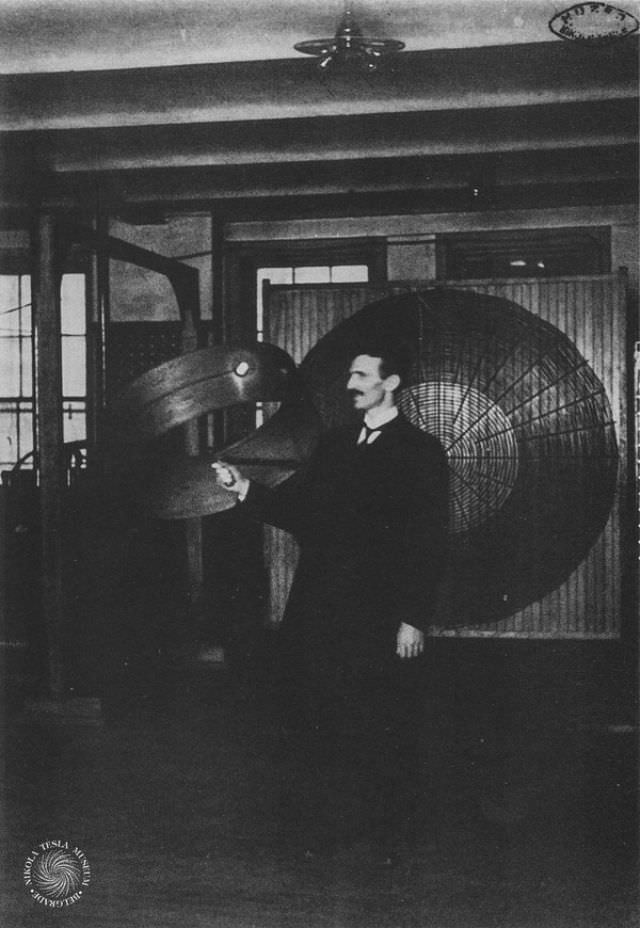
Under the heavy beams of his Houston Street laboratory, Nikola Tesla stands in formal dress beside an outsized coil and a broad, dish-like apparatus, turning a workroom into a stage for electrical wonder. The setting feels half industrial, half theatrical: tall windows, a high ceiling, and the looming circular framework behind him hint at the scale he believed necessary to tame high-frequency currents. Even without sound or motion, the photograph carries the tension of an experiment poised between careful control and raw, unseen force.
In March 1899, Tesla’s idea of “wireless” power transmission was less a slogan than a challenge to the wired world being built around him. The equipment pictured suggests resonant circuits and strong electromagnetic fields—tools meant to move energy through space without direct conductive connections. For readers interested in the history of electricity, early radio science, and the birth of modern inventions, this scene anchors the dream in real hardware: wood, metal, and painstaking arrangement.
Beyond its technical intrigue, the image offers a rare look at the culture of turn-of-the-century experimentation, when laboratories doubled as workshops and proof often depended on dramatic demonstration. Tesla’s calm posture amid such imposing machinery reinforces his reputation as both engineer and showman, inviting us to consider how public spectacle and scientific ambition fed each other. As a historical artifact, it remains a compelling doorway into the era’s fascination with electrification and the enduring mythology of wireless energy.