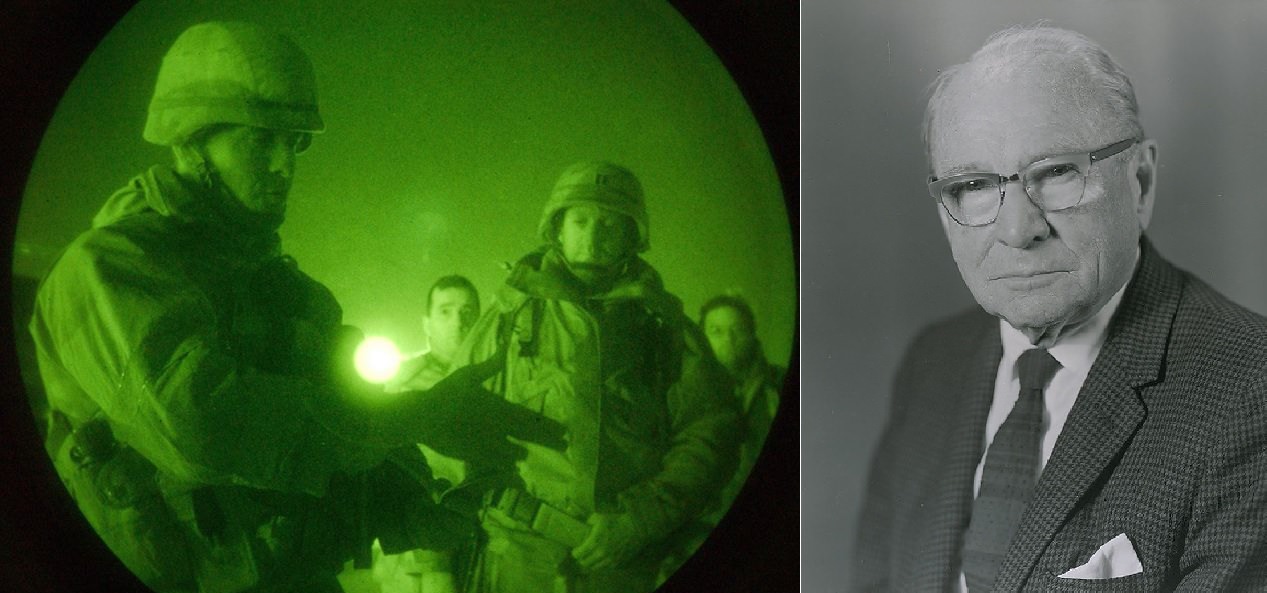
Green light floods a circular viewing screen where helmeted soldiers and shadowy figures gather, their faces emerging from a haze that feels both laboratory-made and battlefield-real. The glow at the center reads like an artificial moon, hinting at early image-intensification experiments meant to pull detail from darkness. In one frame, the viewer is invited to imagine what it meant in 1944 to “see” when ordinary sight failed.
On the opposite side sits Vladimir Zworykin in a formal portrait, composed and deliberate, the kind of calm presence often found behind disruptive inventions. Pairing the inventor’s likeness with the eerie, amplified scene underscores the human hand guiding wartime-era electronics and optics. For readers exploring World War II technology, early night vision, or the roots of modern imaging, “Snooperscope (1944)” lands at a fascinating crossroads of science and necessity.
Rather than focusing on a single battlefield moment, the photo suggests a broader story: research turning into equipment, and equipment reshaping how people moved through the dark. The Snooperscope name itself carries a blend of curiosity and surveillance, capturing the period’s appetite for devices that extended perception beyond natural limits. As a WordPress feature on inventions, this historical image works as a vivid entry point into the lineage that leads from early infrared viewing to today’s night-vision cameras and sensors.