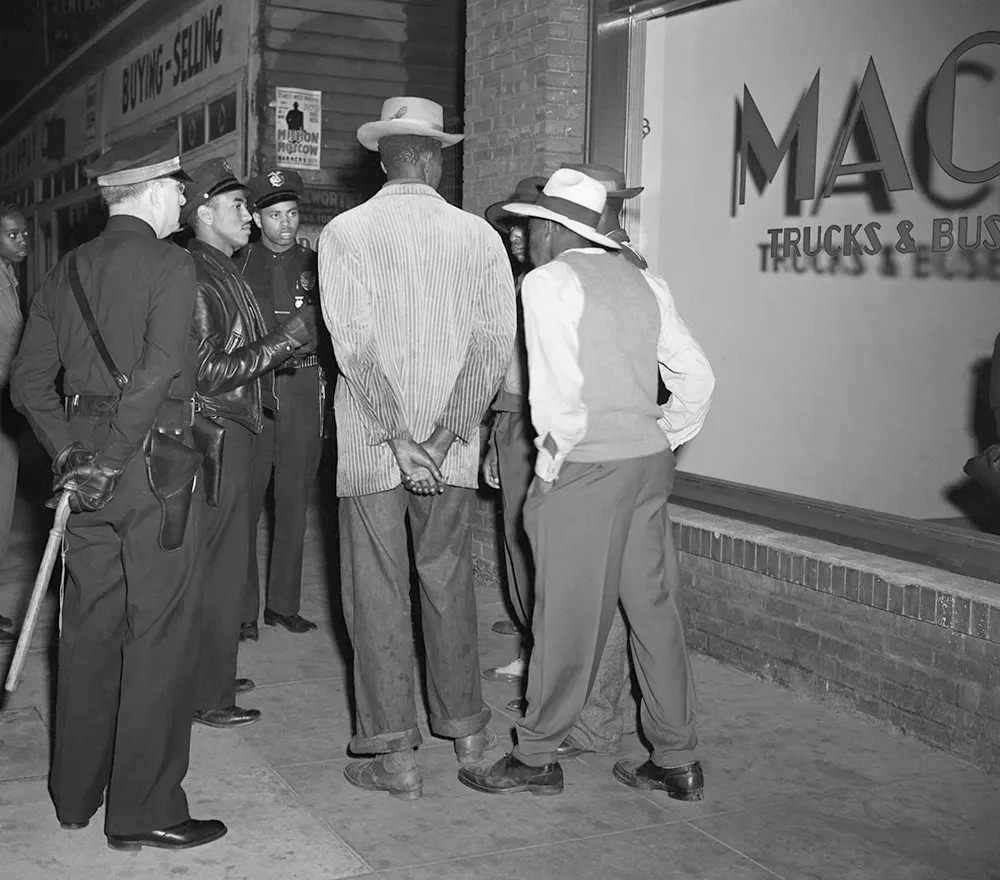
Under the glow of a storefront sign, a knot of Los Angeles policemen closes in on a small group of young men as the city tries to reassert control after the zoot suit rioting. Uniformed officers and a leather-jacketed patrolman stand shoulder to shoulder on the sidewalk, their attention fixed on papers being checked and questions being asked. The men under scrutiny wear the era’s sharp silhouettes—wide-brimmed hats, long coats, and pleated trousers—styles that had become loaded symbols in the public imagination.
Tension radiates through the body language: hands clasped behind backs, heads angled toward the exchange, faces half-turned in watchful silence. Draft credentials, ordinary documents in wartime America, become a tool of authority and a test of belonging, transforming a routine check into a moment of judgment. Even the brick wall and plate-glass window frame the encounter like a stage, emphasizing how public and performative policing could be on the streets of Los Angeles.
Fashion and culture sit at the center of the story, not as harmless trends but as markers that drew suspicion and triggered crackdowns. The zoot suit—bold, defiant, and instantly recognizable—was treated by many as evidence of disorder, making clothing itself a kind of accusation. Seen today, the photograph offers a stark window into the aftermath of the Zoot Suit Riots, where identity, wartime patriotism, and law enforcement collided in a highly charged civic landscape.