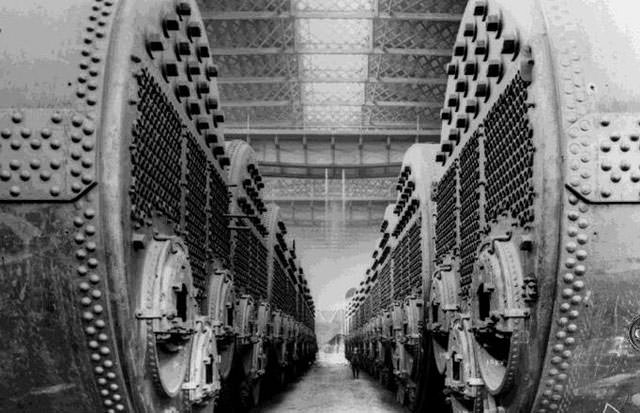
Riveted steel dominates the frame, forming a canyon of machinery that hints at the sheer industrial muscle required to bring the Titanic to life. Rows of massive cylindrical forms—each banded with bolts and plates—stretch into the distance beneath a high, latticed roof, turning a workshop interior into something almost cathedral-like. For readers searching Titanic construction history, the scene offers a close, tactile sense of how “unsinkable” confidence was forged: not as a slogan, but as metalwork measured in thousands of fasteners and painstaking alignment.
Between these looming surfaces, the eye is drawn down a narrow corridor where light fades into haze, suggesting heat, noise, and constant motion just beyond the camera’s view. The repeating patterns of rivets and seams speak to the era’s shipbuilding methods, when strength came from layered plates and the disciplined labor of teams who drilled, fitted, and hammered with relentless precision. Even without visible faces, the photograph feels crowded with human effort—an intimate look at the infrastructure that powered a legend’s rise to fame.
What makes this kind of historical photo so compelling is its ability to translate an iconic ocean liner into the language of invention and engineering. The Titanic is often remembered for her maiden voyage and tragic end, yet images like this pull the story back to the shipyard, where innovation lived in details: standardized components, heavy-duty fabrication, and industrial-scale assembly. As a WordPress feature, it’s a strong reminder that maritime history isn’t only told on the sea; it begins in workshops like this, where ambition was bolted together one section at a time.