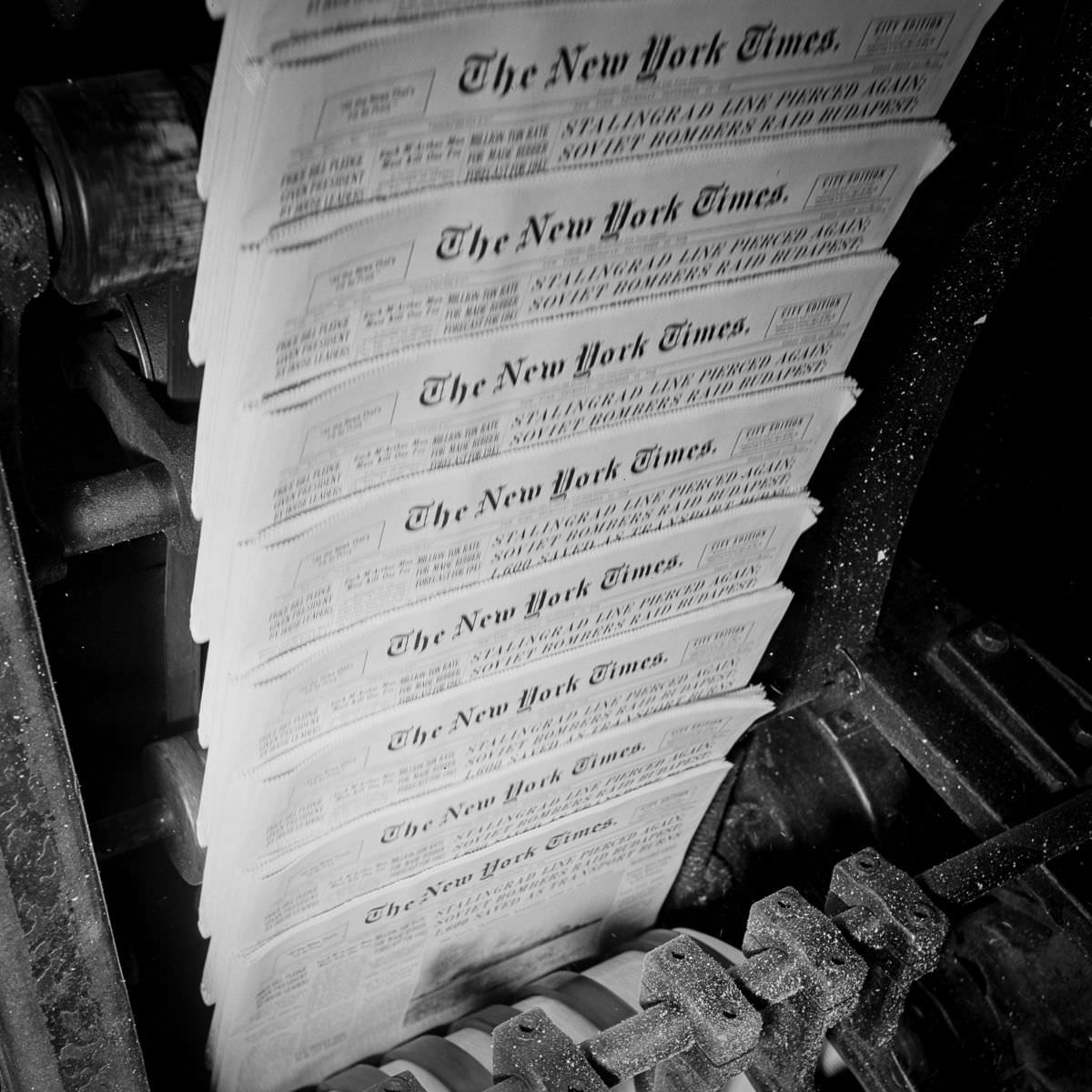
Freshly printed newspapers surge forward in a tidy cascade, their mastheads repeating in quick succession as they ride the final stretch of a production line. The frame draws the eye to the precise edges and uniform folds, while the surrounding machinery—rollers, guides, and ink-dusted metal—reminds us how physical and industrial the daily news once was. In this moment, the printed page is not yet a morning ritual on a doorstep; it is a manufactured object moving at speed.
Beneath the rhythm of the conveyor belt lies an ingenious bit of workflow: every fiftieth copy is set at a slight angle to make counting faster and less error-prone. That small slant, easy to miss at first glance, speaks volumes about the scale of mass circulation and the need for efficiency in a busy pressroom. Cutting and folding machines did more than save labor—they standardized the product so distribution could happen like clockwork.
Industrial printing history often gets reduced to grand claims about progress, yet photographs like this bring it back to the mechanics of paper, timing, and motion. The scene offers a vivid glimpse into the technologies that shaped modern journalism, where speed and consistency mattered as much as the headlines themselves. For readers interested in newspaper production, print machinery, and the evolution of publishing inventions, this image captures the quiet precision behind the daily flood of information.