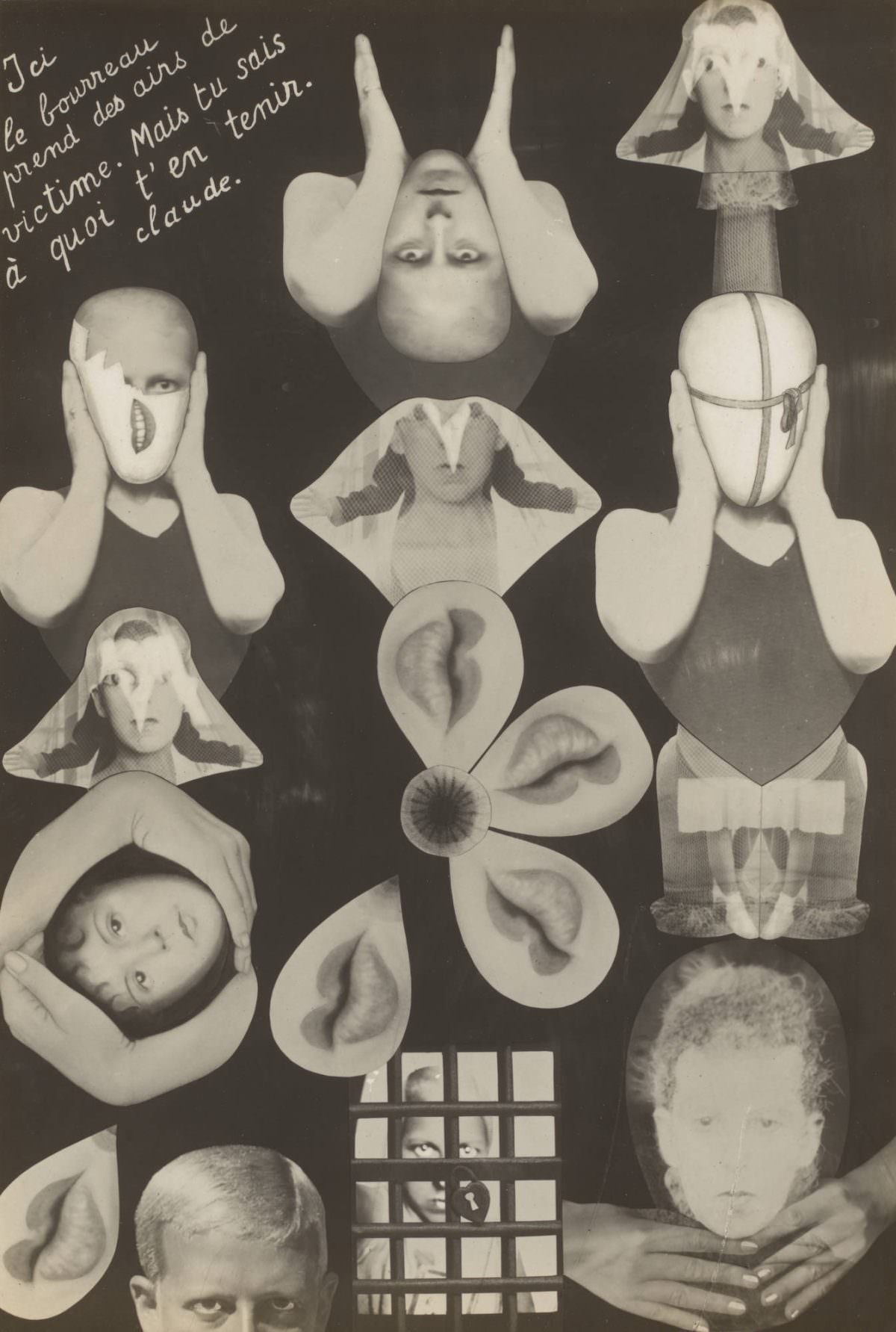
Against a deep, shadowed background, Claude Cahun (Lucy Schwob) appears in 1929 through a startling collage of repeated faces and fragmented features. Heads are turned upside down, pressed between hands, or partially hidden behind smooth, mask-like coverings, while cut-out lips and ears bloom like a surreal flower at the center. A handwritten French line in the upper corner adds a note of intimate address, as if the artwork is speaking directly to the viewer.
The composition reads like a visual argument about identity: multiplied, rearranged, and deliberately unsettled. Cahun’s gaze shifts from panel to panel—sometimes direct, sometimes obscured—suggesting performance, self-invention, and refusal of a single fixed self. The play between skin, costume-like shapes, and theatrical concealment gives the image its tension, drawing the eye from the crisp geometry of the cutouts to the uncanny softness of the photographed face.
For anyone searching for Claude Cahun photography, Surrealist portraiture, or avant-garde self-portrait experiments of the interwar period, this 1929 work offers a powerful entry point. It is less a straightforward likeness than a carefully constructed psychological stage, where repetition becomes a method and masking becomes a language. The result remains modern in its questions—about persona, vulnerability, and the shifting boundaries between the private self and the image presented to the world.