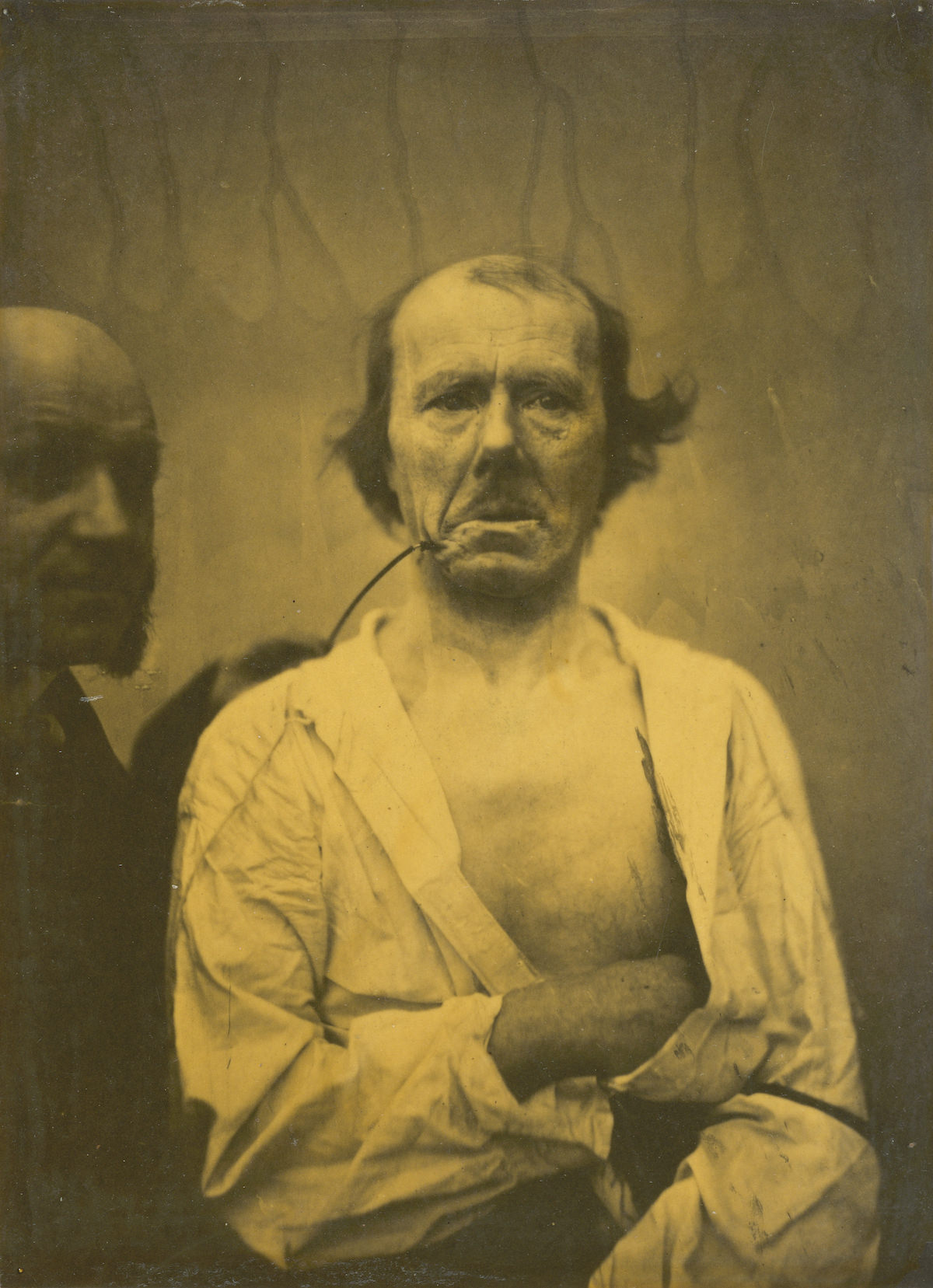
A taut mouth, drawn slightly to one side, turns the sitter’s face into a study of discomfort, as if the very idea of “disgust” has been carefully posed for the camera. The man’s shirt hangs open and rumpled, his arms folded in a guarded stance that makes the expression feel more deliberate than fleeting. A thin, reed-like object curves from the corner of his lips, adding a curious note that heightens the sense of performance and observation.
Along the left edge, another figure—only partly visible—hovers in soft focus, suggesting a studio setting or an assistant standing just outside the formal frame. The background remains plain and indistinct, keeping attention fixed on skin, fabric, and the muscular effort of the face as it holds an emotion in place. Even without a clear setting, the photograph reads like an “artwork” in the older sense: an image made to teach the eye how to see.
Placed under the title “A relaxed expression (left); Disgust (right),” the piece invites comparison, as though it belongs to a series of historical facial-expression studies. Viewers can linger over the tension in the brow and the downturned lips, then imagine how radically the mood would shift with only a small change in the muscles around the eyes and mouth. For anyone searching for antique expression photography, early visual psychology, or the history of portraiture, this striking close view offers a memorable lesson in how emotions were staged, recorded, and read.