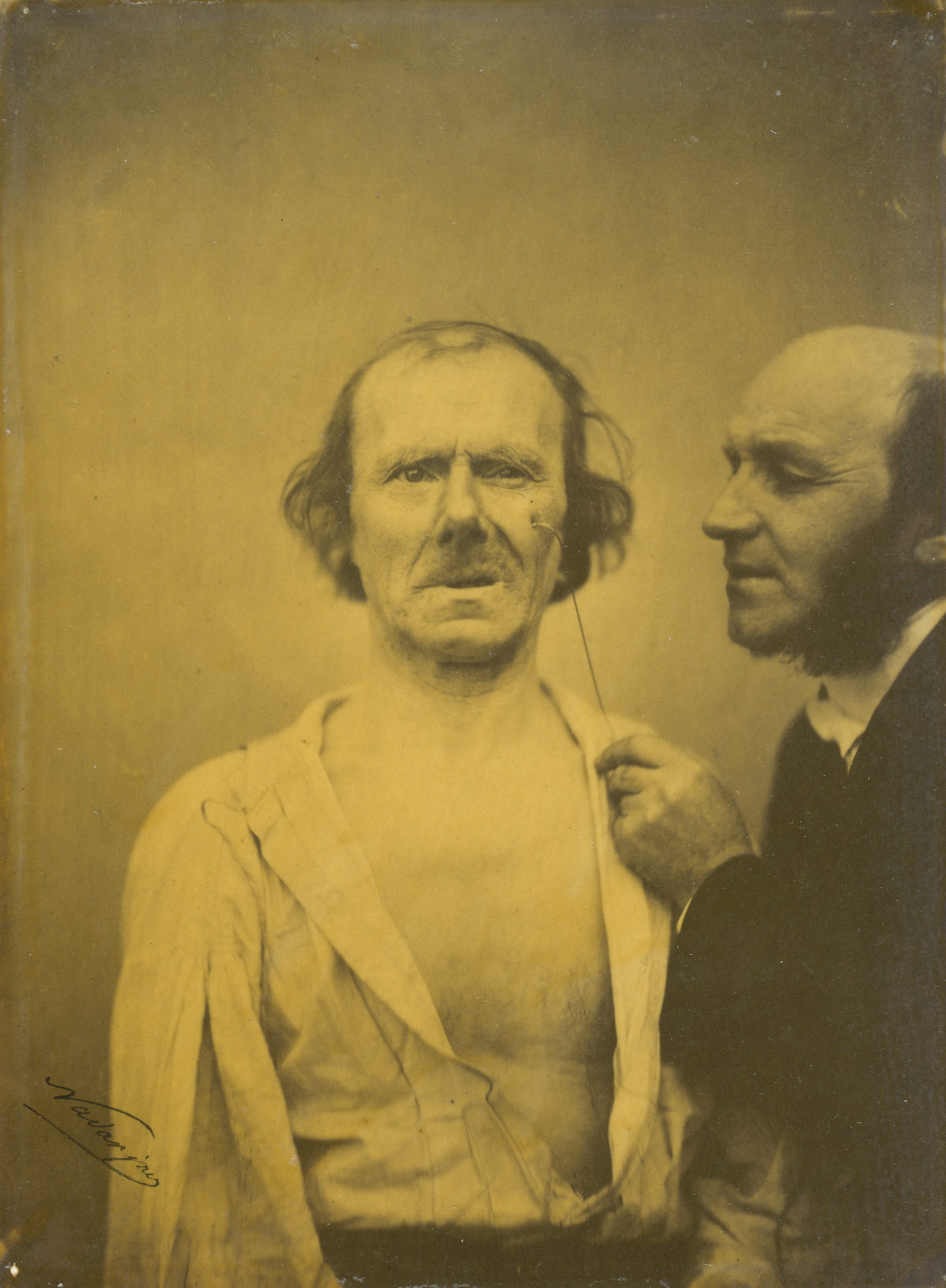
Two contrasting expressions are staged with almost theatrical clarity: at left, a man faces the camera with dampened eyes and a tightened mouth, the look of weeping or pity held in place; at right, his profile softens into a more relaxed, settled face. The simple backdrop keeps attention on the shifting muscles around the brow, nose, and lips, inviting a close reading of emotion as something observable and recordable.
What makes the scene especially intriguing is the presence of another figure leaning in, hand raised with a slender tool near the subject’s cheek, as if adjusting a tear track or refining a facial detail for the lens. That small gesture turns the photograph into a study not only of feeling but of fabrication—how nineteenth-century and early studio practices could choreograph “natural” expression for art, science, or demonstration. The open shirt and direct, unflinching pose amplify the sense of vulnerability, while the warm, aged tones and surface wear emphasize its survival through time.
For readers interested in the history of photography and the visual culture of emotion, “Weeping, tears of pity (left); Relaxed face (right)” offers a compact lesson in how faces were cataloged, compared, and interpreted. It works as both artwork and document, balancing intimacy with experiment, and reminding us that even a tear can be part performance. This post explores the image’s expressive details and why such studies still matter to historians of portraiture, early photographic technique, and the enduring language of the human face.