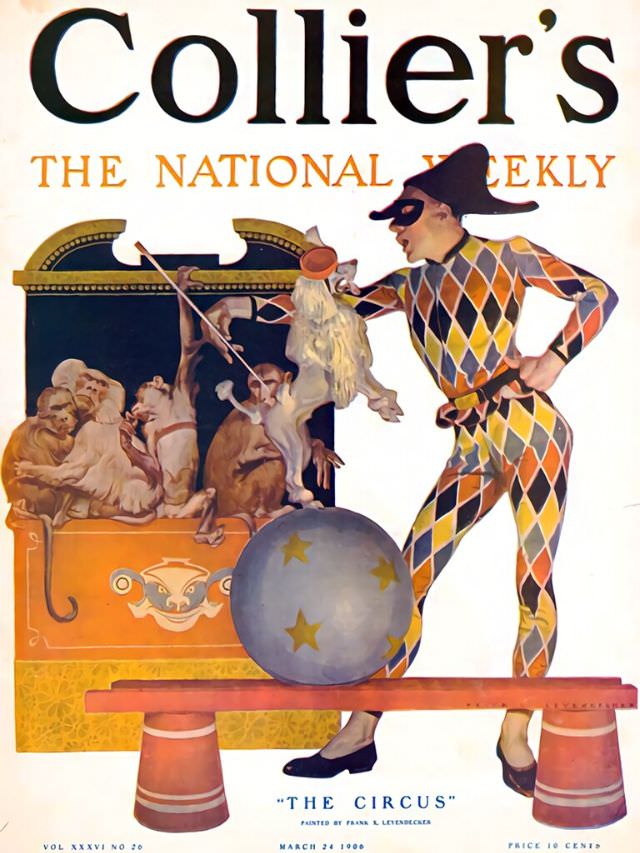
Bold lettering crowns the cover—“Collier’s, The National Weekly”—while a riot of circus color takes over the page beneath it. A harlequin performer in a diamond-patterned costume and mask leans toward a small act in motion: a fluffy white dog balances neatly on a large ball marked with stars, all set on a narrow platform. Behind them, an ornate, gilded frame-like opening suggests a stage or booth where a cluster of pale figures huddle together, heightening the sense of spectacle and curious onlookers.
The illustration’s drama is built from contrast: crisp white space around the masthead, warm oranges and yellows in the costume, and deep blues in the background panel. The performer’s posture—one hand braced on the hip, the other angled toward the balancing dog—guides the eye through the composition like a ringmaster’s cue. Decorative flourishes along the lower edge and the stylized theatrical setting evoke the era’s love of poster art and magazine covers that doubled as collectible artworks.
For anyone browsing early 20th-century print culture, this Collier’s magazine cover dated March 24, 1906 offers a vivid snapshot of how mainstream weeklies packaged entertainment and modern illustration. The caption “The Circus” anchors the theme, making it a strong keyword-rich piece for collectors and researchers searching for Collier’s covers, vintage magazine art, and classic circus imagery. Whether you’re drawn to the graphic design, the playful performance scene, or the period typography, it’s a striking example of how a single cover could sell a story before the first page was even turned.